

How the Canton Network Is Changing Institutional Blockchain Infrastructure

CyberScope
May 27, 2026
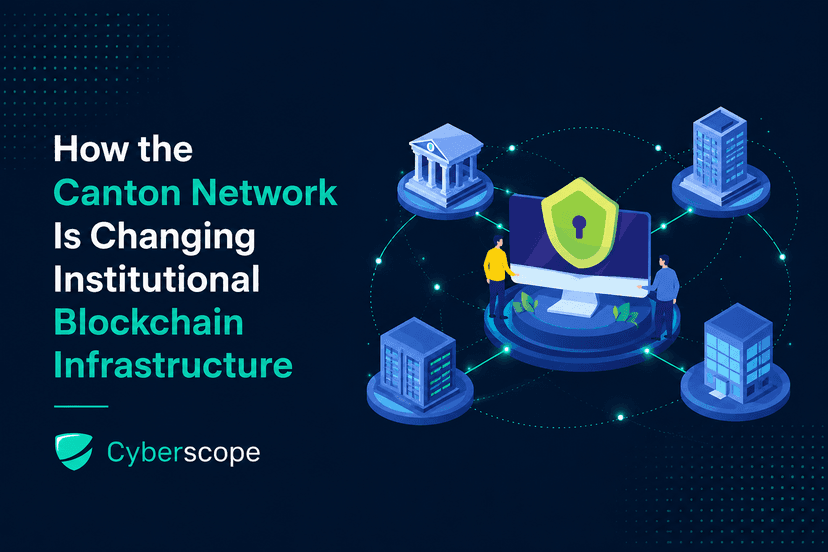
How the Canton Network Is Changing Institutional Blockchain Infrastructure
The blockchain industry has spent years promising faster payments, decentralized systems, transparent financial infrastructure, and frictionless global transactions. While these innovations transformed areas such as cryptocurrencies, decentralized finance, and digital assets, large financial institutions have historically struggled to adopt traditional blockchain infrastructure at scale.
One of the biggest reasons is privacy.
Most public blockchain ecosystems were built around transparency. Networks such as Bitcoin and Ethereum allow users to publicly inspect wallet activity, transaction history, and smart contract interactions. While this level of transparency works well for decentralized ecosystems, it creates serious limitations for banks, asset managers, payment providers, and regulated enterprises.
Financial institutions cannot expose sensitive transaction data, client activity, internal operations, trading positions, or settlement workflows publicly on-chain. Regulatory obligations, confidentiality requirements, and operational security standards make this nearly impossible.
This is exactly why the Canton Network is becoming one of the most discussed enterprise distributed ledger infrastructures within institutional finance.
What Is the Canton Network?
The Canton Network is a decentralized synchronization network / distributed ledger infrastructure for interoperable applications developed by Digital Asset. Unlike traditional public blockchain systems, the Canton Network was specifically designed for institutional finance and enterprise-grade applications.
The network enables organizations to securely process, synchronize, and share transactions without exposing confidential information to every participant on the network.
This is one of the most important distinctions between Canton and many traditional blockchain ecosystems.
Many public blockchains expose transaction visibility to validators and public observers. Canton takes a fundamentally different approach by introducing selective privacy and controlled data visibility. Participants only access the information relevant to them, while unrelated parties remain unable to view sensitive transaction details.
In practice, this creates an infrastructure that combines distributed ledger technology with enterprise privacy requirements, programmable finance capabilities, interoperability across multiple systems, and secure settlement architecture.
This combination is precisely why the Canton Network is attracting attention from major financial institutions globally.
Why Privacy Matters in Institutional Blockchain
Privacy is one of the largest barriers preventing traditional financial institutions from fully embracing public blockchain infrastructure.
Banks operate in heavily regulated environments where customer data, trading information, internal transfers, and financial agreements cannot be publicly disclosed. Asset managers, clearinghouses, insurance providers, and payment processors face similar constraints.
Public blockchain systems were never originally designed around institutional confidentiality.
The Canton Network introduces a privacy-first architecture that directly addresses this issue. Instead of broadcasting all transaction activity across the network, Canton ensures that information is shared only with authorized participants involved in a specific transaction or workflow.
This allows institutions to collaborate on a shared distributed ledger infrastructure while still maintaining strict confidentiality and compliance standards.
For enterprise adoption, this changes everything.
Financial institutions no longer need to choose between the efficiency of blockchain technology and the privacy obligations required by regulators and clients. The Canton Network was specifically designed to support both.
How the Canton Network Differs From Traditional Blockchains
One of the most important aspects of understanding the Canton Network is recognizing how different it is from conventional public blockchain ecosystems.
Most public blockchain networks prioritize decentralization and transparency above all else. In many public blockchain ecosystems, validators and public participants can inspect wallet balances, token transfers, and contract interactions. While this approach works for open cryptocurrency ecosystems, it creates significant limitations for institutional finance.
The Canton Network instead focuses on controlled visibility, interoperability, enterprise-grade security, and regulatory compatibility.
This makes the network much more aligned with how real-world financial infrastructure already operates today.
Traditional financial institutions rely on permissioned access, secure settlement systems, private transaction coordination, and controlled operational environments. Canton integrates these requirements directly into its distributed ledger and synchronization architecture rather than treating them as secondary features.
The result is a distributed ledger network specifically optimized for institutional collaboration instead of public speculation.
Interoperability Across Financial Systems
Another major challenge within enterprise blockchain adoption is fragmentation.
Most financial institutions rely on a combination of legacy infrastructure, third-party software providers, internal databases, settlement systems, and proprietary operational platforms. Completely replacing these systems is unrealistic for most organizations.
This is where the Canton Network becomes particularly interesting.
Rather than forcing enterprises to abandon their existing infrastructure, Canton acts as a synchronization layer that securely connects multiple systems together and supports coordinated workflows across shared domains.
This interoperability-focused architecture allows organizations to integrate distributed ledger infrastructure gradually while preserving existing operational processes.
For financial institutions, this creates a much more practical path toward blockchain adoption.
Instead of rebuilding everything from scratch, organizations can connect systems together, automate workflows, improve coordination, and streamline settlement processes while maintaining operational continuity.
This interoperability model may ultimately become one of the biggest drivers of institutional blockchain adoption over the coming years.
Atomic Settlement and Reduced Financial Risk
Settlement risk has historically been one of the most important operational concerns within financial markets.
In traditional systems, transactions can sometimes fail partially, creating situations where one side of a transaction completes while the other does not. This creates operational inefficiencies, counterparty risk, and additional reconciliation challenges.
The Canton Network supports atomic settlement mechanisms designed to reduce these risks.
Atomic transactions ensure that either the full transaction executes successfully or the transaction fails entirely. There is no partial completion state.
For institutional finance, this can significantly improve transaction security, operational efficiency, settlement reliability, and counterparty trust.
As digital assets and tokenized financial products continue expanding globally, secure settlement infrastructure will become increasingly important. Networks capable of supporting efficient atomic settlement may play a central role in the future of programmable finance.
Why Major Institutions Are Exploring Canton Network
One of the strongest indicators of the Canton Network’s relevance is the growing involvement of major financial institutions and infrastructure providers.
According to publicly available information, organizations associated with the Canton ecosystem through participation, governance, infrastructure, or collaboration include Goldman Sachs, BNP Paribas, Microsoft, DTCC, and Broadridge.
The involvement of these organizations signals increasing enterprise interest in blockchain infrastructure that balances privacy, interoperability, compliance, and operational efficiency.
Large financial institutions are not simply looking for speculative blockchain projects. They are searching for infrastructure capable of supporting real-world financial workflows securely and at scale.
The Canton Network appears to be positioning itself directly within this category.
DAML and Smart Contract Infrastructure
The Canton Network also works closely with DAML, short for Digital Asset Modeling Language. DAML is a smart contract language designed specifically for modeling real-world agreements, workflows, and financial operations.
In simple terms, DAML manages the business logic and contractual rules while Canton provides the secure distributed infrastructure and synchronization model where those agreements operate.
This combination enables organizations to automate complex workflows while maintaining security, privacy, and operational consistency.
As financial systems continue evolving toward programmable assets and digital settlement infrastructure, smart contract frameworks capable of supporting enterprise-grade operations will become increasingly valuable.
Security Challenges in Institutional Blockchain Infrastructure
Despite the advantages of blockchain technology, security remains one of the biggest concerns for institutional adoption.
Smart contract vulnerabilities, operational misconfigurations, wallet compromises, authorization failures, workflow logic issues, and protocol attacks have resulted in billions of dollars being lost across the Web3 ecosystem over the last few years.
Institutional participants require significantly higher security standards than typical retail environments.
This is why blockchain security solutions, smart contract auditing, transaction monitoring, and AI-powered risk analysis are becoming essential components of modern blockchain infrastructure.
As enterprise blockchain ecosystems expand, the ability to continuously analyze risk exposure and detect vulnerabilities proactively will become increasingly important.
Platforms such as Cyberscan AI are part of this broader shift toward AI-powered blockchain security analysis. AI-driven security infrastructure helps organizations identify suspicious patterns, contract vulnerabilities, operational risks, and potential weaknesses faster than traditional manual-only approaches.
As institutional blockchain networks become more interconnected, AI security tools will likely play a growing role in helping organizations manage risk across complex digital asset ecosystems.
The Growing Importance of Tokenization
One of the biggest trends driving interest in networks like Canton is tokenization.
Tokenization refers to the process of representing traditional assets such as bonds, equities, real estate, commodities, or financial agreements on distributed ledger infrastructure.
Many financial institutions believe tokenization could eventually improve settlement efficiency, reduce operational costs, increase transparency, and streamline asset management.
However, large-scale tokenization requires infrastructure capable of supporting enterprise privacy, compliance, interoperability, and secure settlement.
This is precisely where the Canton Network positions itself.
Instead of focusing primarily on public cryptocurrencies, Canton focuses on enabling institutions to coordinate tokenized financial systems securely and efficiently.
As tokenized finance continues evolving, networks specifically designed for institutional infrastructure may become increasingly important within the broader financial ecosystem.
The Future of Institutional Blockchain
The blockchain industry is gradually moving beyond early-stage experimentation.
Large financial institutions are no longer simply observing the technology from a distance. Many are actively exploring how distributed ledger infrastructure can improve settlement systems, digital asset management, operational efficiency, and cross-system coordination.
However, enterprise adoption requires much more than transaction speed or decentralization.
Institutions require privacy, compliance, interoperability, scalability, security, and operational reliability.
The Canton Network addresses many of these concerns directly through its enterprise-focused architecture.
Rather than attempting to replace traditional finance entirely, Canton focuses on improving how institutions interact, settle, and share information securely.
This approach may ultimately prove more practical for large-scale institutional adoption.
As blockchain infrastructure matures, networks like Canton could become foundational components of the next generation of financial systems.
Final Thoughts
The Canton Network represents a significant evolution in enterprise blockchain infrastructure.
While many blockchain ecosystems were originally built around transparency and public participation, Canton was specifically designed around the operational realities of institutional finance.
Its focus on privacy, interoperability, controlled data visibility, atomic settlement, and enterprise-grade coordination makes it one of the most important distributed ledger infrastructures currently emerging within the institutional market.
As tokenization, programmable finance, and digital asset adoption continue expanding globally, the need for secure and compliant blockchain infrastructure will only increase.
At the same time, blockchain security will remain a critical priority. Smart contract vulnerabilities, operational risks, and complex digital asset ecosystems require increasingly sophisticated security solutions. AI-powered security analysis platforms such as Cyberscan AI are becoming increasingly relevant as institutions search for scalable ways to monitor and secure blockchain infrastructure.
The future of institutional blockchain will likely depend not only on innovation, but also on trust, security, interoperability, and privacy.
The Canton Network is positioning itself directly at the center of that evolution.
Recent Posts
Cryptocurrency Security Standard: What Is CCSS?
2 months ago
Blockchain and Web3 Incident Response
2 months ago