

Blockchain Forks Explained

CyberScope
Jul 12, 2026
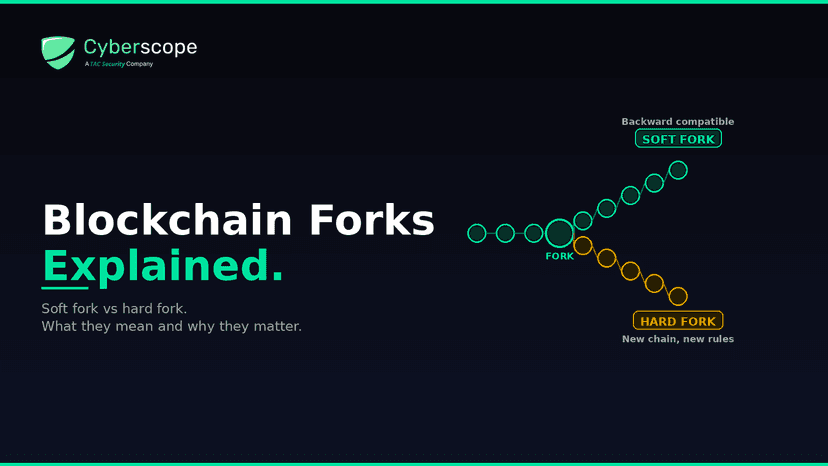
Soft Fork vs Hard Fork
Anyone who spends enough time around blockchain networks eventually runs into the word fork, usually attached to a headline about a coin splitting in two or a network suddenly gaining new features overnight. For newcomers, it can sound alarming, as if the entire system is breaking apart. In reality, a blockchain fork is simply what happens when the underlying rules of a network are changed, and understanding how that process works is one of the more useful things you can learn about how decentralized systems actually evolve.
At its core, a fork occurs whenever the rules, structure, or components of a blockchain are modified, whether through a planned upgrade or a more contentious change pushed by part of the community. Depending on how that change is implemented, it either stays backward compatible, in which case it is called a soft fork, or it breaks compatibility entirely, which is what defines a hard fork. A hard fork effectively creates a new version of the blockchain, and nodes still running the old rules get left behind unless they upgrade.
Some of the most talked about hard forks in crypto history happened for reasons that had little to do with pure engineering and everything to do with disagreement. Bitcoin and Bitcoin Cash are the obvious example, as are Ethereum and Ethereum Classic. In both cases, the community could not reach a shared decision on which direction to take the network, so part of it stayed on the original chain while the rest moved forward on the new one. Neither side was technically wrong. They simply wanted different things from the same protocol.
How a Blockchain Fork Actually Works
Centralized systems have it easy in one specific sense: a single company decides when to ship an update, and everyone using that system gets it at the same time whether they like it or not. Blockchains do not have that luxury, and honestly, that is the entire point of decentralization. Implementing a change to a public blockchain requires the participation, or at least the tolerance, of a much wider set of stakeholders, and a fork is usually the mechanism through which that change actually happens on-chain.
It helps to remember that a fork, in the strict technical sense, is nothing more than a change to a blockchain's codebase. Reasons for making that change usually fall into one of a few buckets: patching a bug or closing a security vulnerability, adding new functionality, or improving scalability and overall network performance. You can also check how blockchains reach agreement on which version of the ledger is valid in our piece on what consensus actually means in blockchain, since that mechanism is closely tied to how forks get adopted across a network.
That said, forks are not always a purely technical matter. Plenty of them have started because a portion of the community disagreed with where a project was heading, whether that was a philosophical dispute over decentralization, a fight over block size, or frustration with how a foundation was managing development. When consensus genuinely cannot be reached, a split becomes almost inevitable, and a new, separate chain is born.
Governance and Decision Making
Different blockchains lean on different governance structures to manage this process, and the mechanism matters quite a bit for how smoothly an upgrade actually goes. Some of the more common approaches include:
- DAOs, or decentralized autonomous organizations
- Foundations that steward development and funding
- Formal improvement proposals, the kind Bitcoin and Ethereum both use
- Governance tokens that grant holders a vote
- Direct community voting on specific proposals
These structures exist to give the community a transparent, reasonably structured way to review, debate, and eventually decide on proposed changes, rather than leaving it to whoever happens to run the most popular client software. Typically, once an issue is identified and a proposal is drafted, token holders or node operators review it and vote, and that outcome is what determines whether a fork moves forward as planned.
Fork Implementation and What Happens at the Block Height
Forks are not just announced and left to happen organically. They are usually scheduled to activate at a specific block height, which gives node operators and miners a clear deadline to decide whether they will support the proposed changes. At that point, everyone running a node has to choose: upgrade the software and follow the new rules, or continue running the old version and stick with the original chain.
If only part of the network upgrades while the rest does not, you end up with a genuine network split, producing two separate chains that share a common history up to that block but diverge from that point forward. This is exactly what happened with Bitcoin Cash and Ethereum Classic, and it is worth understanding clearly, since it is the difference between a smooth, unified upgrade and a permanent chain split.
What Is a Soft Fork
A soft fork is a backward compatible upgrade, meaning nodes that have not upgraded yet still recognize blocks produced under the new rules as valid. Nobody is forced to update immediately, and the network as a whole does not split into two competing chains, because everyone remains on speaking terms with everyone else, technically speaking.
A simple analogy makes this easier to picture. Think about updating an app on your phone. You do not have to install the update the moment it becomes available. The app still works perfectly fine without it. You simply miss out on whatever new features shipped with that update, and most people eventually install it anyway just to stay current. That is more or less how a soft fork plays out across a blockchain network. Nodes can delay upgrading without being cut off, though in practice most will upgrade over time to stay aligned with the majority of the network. Changes at the base protocol layer like this are also why so many teams treat layer one security as an ongoing responsibility rather than a one time checkbox, since even a backward compatible change can introduce subtle behavior shifts that are worth reviewing carefully.
What Is a Hard Fork
A hard fork is the opposite scenario: an upgrade that is not backward compatible with the previous version of the protocol. Every node has to upgrade to remain part of the same network going forward. Nodes that stay on the old software will reject blocks produced under the new rules, while upgraded nodes will accept and build on them, and from that point the two groups are effectively running different networks even though they share the same history up to the fork.
Both chains can, and often do, continue to exist in parallel afterward. Whichever chain ends up attracting the majority of nodes, miners, and general adoption is usually treated as the dominant chain going forward, though the other one does not necessarily disappear. Ethereum Classic is still around today, years after the fork that created it.
Soft Fork vs Hard Fork: A Quick Comparison
Feature | Soft Fork | Hard Fork |
|---|---|---|
Chain split | Does not cause a chain split | Can cause a permanent chain split |
Compatibility | Backward compatible with older nodes | Not backward compatible |
Upgrade requirement | Nodes are not required to upgrade | All nodes must upgrade to stay on the network |
Typical cause | Bug fixes, minor protocol tweaks | Major protocol changes, unresolved community disputes |
Well known example | SegWit on Bitcoin | Bitcoin Cash, Ethereum Classic |
Why Forks Matter for Security and Compliance
This is the part that tends to get less attention in most explainers, but it matters just as much as understanding the mechanics. A hard fork does not just change consensus rules. It can quietly break assumptions that smart contracts, wallets, and exchanges were built on. Replay attacks, where a transaction valid on one chain gets rebroadcast and accepted on the other chain as well, have caused real losses during past hard forks, and they remain one of the more underappreciated risks of a contentious network split.
For projects building on a chain that is about to fork, or for teams maintaining smart contracts that depend on specific protocol behavior, it is worth treating a fork the same way you would treat any other major infrastructure change: with a proper security review beforehand. A smart contract audit can catch assumptions in your code that no longer hold once the underlying chain's rules shift, and our overview of how smart contract audits work in 2026 walks through what that process typically covers. If you are budgeting for this kind of review, our breakdown of what it actually costs to audit a smart contract is a reasonable place to start.
It is also worth pairing an audit with ongoing real time monitoring around the fork date itself, since unusual transaction patterns, replay attempts, or unexpected contract behavior tend to show up in the first few hours after a chain splits, not months later. Teams handling infrastructure that touches both sides of a split, such as exchanges or bridges, may also want a dedicated penetration test of their systems before the fork date, since the transition period is exactly when attackers tend to look for gaps.
There is a compliance angle here too, one that gets overlooked more often than it should. A hard fork that produces a new token, the way Bitcoin Cash and Ethereum Classic did, creates a fresh asset that exchanges and custodians need to account for, verify, and in many cases run through standard KYC checks before listing or supporting it. Our guide on KYC versus AML in crypto compliance is a useful reference if you are trying to figure out where a new forked asset fits into your existing compliance obligations. More broadly, our complete guide to web3 security compliance covers how these pieces, audits, monitoring, and compliance, tend to fit together in practice.
Closing Thoughts
The crypto and blockchain space keeps moving, shaped by growing adoption, new technology, and security challenges that never really go away. Forks, whether soft or hard, are one of the main mechanisms that let a decentralized network actually evolve, whether that means patching a vulnerability, improving scalability, or shipping a feature the community has been asking for.
Not every upgrade ends in agreement, and that is fine. When a community genuinely cannot align on the path forward, a hard fork and the resulting chain split are simply what decentralized decision making looks like when it plays out to its natural conclusion. What matters most for builders and users alike is going into a fork with eyes open, understanding the technical mechanics, the security implications, and the compliance questions that come along with it, rather than being caught off guard when block height finally arrives.
This article is for educational and informational purposes only and does not constitute financial advice. Always do your own research before investing.
Recent Posts
Cryptocurrency Security Standard: What Is CCSS?
2 months ago
Blockchain and Web3 Incident Response
2 months ago