

Stablecoins and the Hidden Security Risks Behind Price Stability

CyberScope
Jul 07, 2026
.png&w=828&q=75)
What Are Stablecoins, and Why Do They Matter
Stablecoins are a category of crypto assets built to hold a steady value by pegging each token to an external reference, usually a national currency such as the U.S. dollar, though some are tied to commodities like gold. The promise is simple. Every token in circulation should be redeemable for an equivalent amount of the underlying asset, shielding holders from the wild price swings that define most unpegged cryptocurrencies.
This stability is exactly why stablecoins have become the backbone of so much on-chain activity. They settle transactions quickly, they underpin decentralized finance protocols, they simplify cross-border payments, and they give traders reliable liquidity without having to exit into fiat. The market has responded accordingly. By July 2025, the total stablecoin market capitalization had passed $250 billion, a figure that reflects growing confidence from both retail users and institutions looking for a bridge between traditional finance and blockchain rails, without taking on the volatility of assets like Bitcoin.
But scale brings exposure. The same qualities that make stablecoins useful, wide adoption and a perception of safety, also make them an attractive target. This raises an important question that every issuer, investor, and regulator should be asking: what is a risk associated with stablecoins, and how much of that risk is avoidable with the right safeguards?
What Is a Risk Associated With Stablecoins
The short answer is that stablecoins carry risk on three fronts at once: the code that runs them, the institutions that back them, and the regulatory environment they operate in. A failure in any one of these areas can be enough to break a peg.
The clearest historical example is the collapse of TerraUSD (UST) in May 2022. UST was an algorithmic stablecoin, meaning it had no hard collateral backing it and instead relied on market incentives and a secondary token to hold its price. When confidence cracked, the mechanism unraveled in what is now commonly described as a death spiral, wiping out tens of billions of dollars and dragging down confidence across the broader crypto market. It remains one of the starkest illustrations of what is a risk associated with stablecoins when the design leans entirely on unproven economic assumptions rather than real reserves.
Regulators took notice. Through 2025, four major jurisdictions moved in parallel to bring fiat-backed stablecoins under tighter, e-money style supervision:
- In the United States, the GENIUS Act cleared the Senate on June 18, requiring issuers to be OCC-chartered banks or approved entities, to hold reserves 1:1 in cash or Treasury bills, and to publish monthly disclosures.
- In the European Union, guidance issued on June 25 under MiCA (fully in force since the start of 2025) allows tokens issued by the same licensed group to move freely between EU and non-EU entities.
- South Korea's Digital Asset Basic Act, outlined in a June roadmap, ties bank-issued won-denominated stablecoins to bankruptcy-remote reserve structures.
- Hong Kong's Stablecoin Ordinance, passed on May 21 ahead of an August launch, mandates full reserves, daily reconciliation, and next-day redemption for holders.
Taken together, these frameworks are pushing stablecoins toward the same standards of transparency and accountability expected of regulated payment instruments, which should, over time, reduce systemic risk even as adoption grows.
The Different Types of Stablecoins, and Where Their Weaknesses Lie
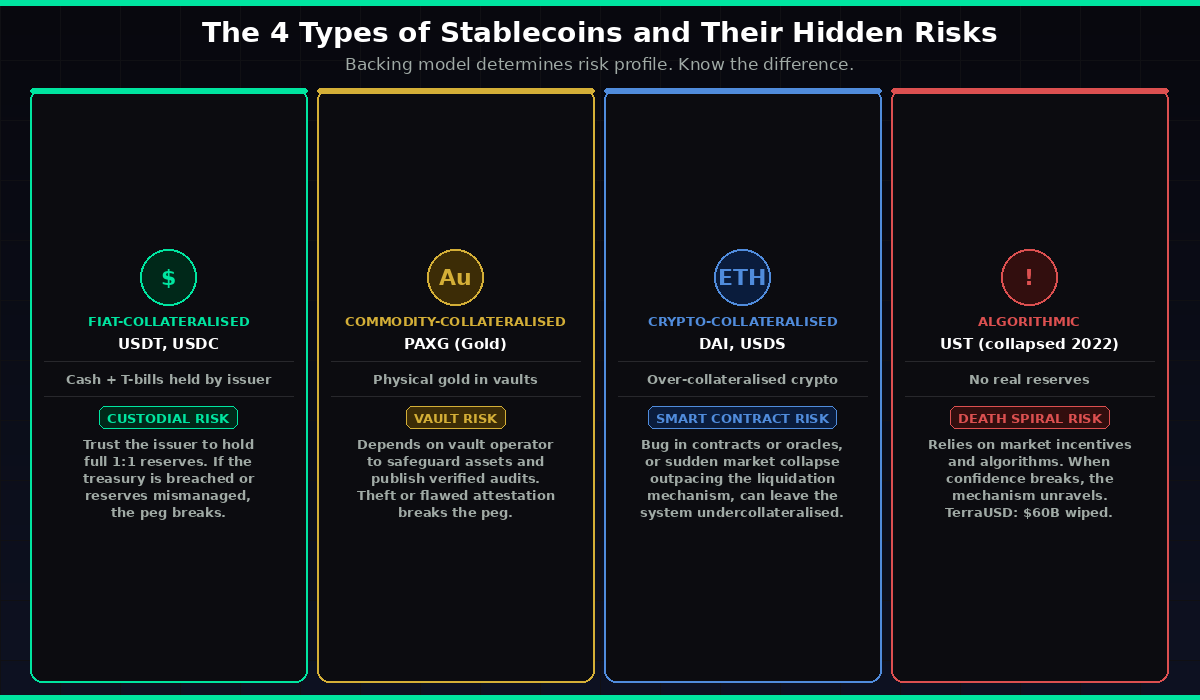
Not every stablecoin is built the same way, and the backing model behind a token largely determines its risk profile. Stablecoins are typically grouped by collateral type, though they can also be classified by their degree of centralization, their peg mechanism, or how they generate yield.
Fiat-Collateralized Stablecoins
These are backed 1:1 by reserves of fiat currency or close equivalents, held by a central issuer. USDC and USDT are the best known examples, generally holding a mix of cash and short-term instruments like Treasury bills. The model is easy to understand: one token equals one unit of fiat, redeemable on demand. The tradeoff is that users must trust the issuer to actually hold what it claims and to honor redemptions when asked. If the issuer's treasury is breached, or reserves are mismanaged or frozen by a government, the peg can come under serious pressure almost overnight.
Commodity-Collateralized Stablecoins
Here, tokens are backed 1:1 by a physical commodity, most often gold, though silver, platinum, and oil have all been used. Pax Gold (PAXG) is the standout example, with each token representing one fine troy ounce of gold stored in LBMA-approved vaults in London. Conceptually, this works like a fiat-backed coin, just with a bar of metal standing in for a bank deposit. The risk shifts accordingly. Holders depend on the vault operator to safeguard the physical asset, publish regular third-party attestations, and process redemptions without friction. Theft, seizure, or a flawed audit can break the peg just as easily as a bank run would.
Crypto-Collateralized Stablecoins
Tokens like DAI or USDS are backed by other cryptocurrencies rather than cash. Users lock volatile assets, often Ether, into smart contracts and typically over-collateralize to absorb price swings. The upside is decentralization: reserves live on-chain and are verifiable by anyone. The downside is that everything depends on the smart contracts and price oracles working correctly. A bug in either, or a sudden and severe market downturn that outpaces the liquidation mechanism, can leave the system undercollateralized and the peg broken.
Non-Collateralized (Algorithmic) Stablecoins
This is the most experimental category, relying on algorithms and market incentives rather than real reserves to hold a price. Some use a secondary token, others adjust supply dynamically. TerraUSD is the cautionary tale here, having lost its peg and erased more than $60 billion in value once confidence turned. A handful of newer projects attempt a hybrid model with partial collateral, but the underlying mechanism is still largely unproven, and any issuer considering this route should treat it with a high degree of caution.
What Would Happen if a Stablecoin Has Vulnerabilities
This is where the abstract becomes concrete. What would happen if a stablecoin has vulnerabilities is not a hypothetical question. It has already played out multiple times, at real cost.
Smart Contract Exploits
Smart contract risk sits at the center of concern for any decentralized stablecoin, or any stablecoin plugged into DeFi protocols. These systems run on code, and flawed code is an open invitation. Attackers routinely look for overflow and underflow bugs, reentrancy flaws, missing access controls, oracle manipulation, and flash loan attack vectors, any of which can be used to mint tokens improperly or drain the collateral behind them. Learn how to check if a smart contract is safe.
Cashio, a decentralized stablecoin on Solana backed by interest-bearing Saber USD liquidity provider tokens, learned this the hard way in 2022. The protocol failed to verify that the banking token and the minted token actually matched, which let an attacker deposit worthless collateral and mint real CASH tokens against it. The result was a loss of roughly $52.8 million, all stemming from a single missing validation check.
A more recent case came on June 26, 2025, when Resupply suffered an exploit in its wstUSR market worth an estimated $9.6 million. The attacker manipulated a low liquidity curve market to distort the exchange rate, then borrowed close to $10 million in Resupply USD without posting any real collateral.
The lesson from both incidents is the same. Before a stablecoin ever reaches production, its contracts need a thorough, independent security review. Formal verification and exhaustive testing catch the kind of logic errors that, left unchecked, become headline-making exploits.
Learn more about the cost of smart contract audits .
Custodial and Off-Chain Failures
Secure code is only half the equation. Stablecoins also depend on off-chain infrastructure, private key management, banking relationships, and internal operational controls, and a weakness anywhere in that chain can undo even a flawless smart contract. Centralized issuers carry custodial risk by definition. They must protect the keys that control minting and redemption, and they must protect the actual assets sitting in bank accounts or custody arrangements. Decentralized stablecoins are not exempt either, since many rely on cross-chain bridges and oracles that carry their own attack surface.
Tether's 2017 incident remains a good illustration. Hackers compromised Tether's treasury systems and moved roughly $31 million worth of USDT out of the Tether Treasury wallet after gaining control of the relevant keys. Tether had to push emergency protocol updates just to freeze the stolen tokens and stabilize market confidence. Even a stablecoin with years of track record can be undone by a single off-chain lapse.
Reducing this kind of exposure takes deliberate, organization-level security practices: penetration testing against web portals, APIs, key storage systems, and internal networks, paired with strong operational controls like multi-signature custody and hardware security modules, so that no single point of failure can put reserves or minting authority at risk.
Compliance Gaps and Proof-of-Reserve Failures
Not every risk shows up as a hack. Some of the most damaging events in stablecoin history have come from a gap between what an issuer claims and what it can actually prove. Regulators everywhere are paying closer attention to consumer protection, anti-money laundering controls, and reserve adequacy, and falling short on any of these can mean fines, forced shutdowns, or a slow erosion of user trust that is just as damaging in the long run.
Tether again offers a cautionary example. In 2019, a legal filing from Tether's own counsel revealed that USDT was only about 74 percent backed by cash or cash equivalents at that point, far short of the full 1:1 backing the market had assumed. The disclosure triggered regulatory settlements and pushed Tether toward greater transparency, but it also showed how a hidden reserve shortfall can quietly build into a systemic problem. More recently, Tether chose to step back from the European market altogether rather than meet the region's stricter licensing requirements, leading exchanges across Europe to delist USDT.
The takeaway is straightforward. Transparent, independently verified reserves matter just as much as clean code. Issuers that commit to regular third-party audits and public attestations give both regulators and users a real reason to trust the peg, rather than simply hoping it holds.
How Cyberscope Helps Stablecoin Issuers Manage These Risks
Given everything above, the practical question for any team building or backing a stablecoin is not whether risk exists, but how to manage it systematically. This is where Cyberscope's services map directly onto each category of risk described above.
Smart Contract Audits. A full review of a stablecoin's code and logic, checking minting, redemption, and collateral management functions against known vulnerability classes, with a mathematical approach to confirm the program behaves exactly as intended.
Penetration Testing. A proactive assessment of an issuer's web portals, APIs, cloud infrastructure, and internal networks, using the same techniques a real attacker would, so weaknesses are found and fixed before anyone else finds them.
KYC Verification. Rigorous identity verification for project teams and counterparties, supporting compliance obligations and giving investors and partners confidence in who they are dealing with.
Smart Contract Real-Time Monitoring. Continuous, on-chain surveillance that flags unusual minting activity, abnormal transaction patterns, or signs of an ongoing exploit, so issuers can respond in minutes rather than days.
Smart Contract Development. For teams building a stablecoin from the ground up, secure-by-design development support that bakes in access controls, collateral checks, and audit-friendly architecture from the first line of code.
Stablecoins will keep growing in importance as the bridge between traditional finance and blockchain systems, and the regulatory momentum seen across the U.S., the EU, South Korea, and Hong Kong in 2025 shows that oversight is only going to get tighter. For issuers, the safest path forward is treating security and compliance as a single, ongoing discipline rather than a box to check before launch. Cyberscope's audit, monitoring, and compliance services are built to support exactly that kind of long-term, ecosystem-wide protection.
Recent Posts
Cryptocurrency Security Standard: What Is CCSS?
2 months ago
Blockchain and Web3 Incident Response
2 months ago