

Cryptocurrency Security Standard: What Is CCSS?

CyberScope
Aug 07, 2026
What Is the Cryptocurrency Security Standard?
The Cryptocurrency Security Standard, usually shortened to CCSS, is a security framework built specifically for organizations that store, transact with, or accept cryptocurrency. Unlike a general cybersecurity framework, CCSS does not try to cover every aspect of how a company protects its systems. It focuses narrowly and deliberately on the part that makes crypto genuinely different from traditional finance: the handling of cryptographic keys and seeds, the assets they control, and the operational processes surrounding them.
That narrow focus is actually the point. General frameworks like ISO 27001 or SOC 2 cover broad information security practices, but neither was built with crypto specific risks like private key generation, multisig custody, or wallet compromise protocols in mind. CCSS exists to fill exactly that gap, sitting alongside those broader frameworks rather than replacing them.
Who Created CCSS, and Why It Exists
CCSS was developed by the CryptoCurrency Certification Consortium, generally referred to as C4, and first introduced in the mid-2010s as the crypto industry started grappling with a pattern that is still painfully familiar today: exchanges, custodians, and wallet providers getting breached, often through weaknesses that had nothing to do with the blockchain itself and everything to do with sloppy key management, unclear internal policies, or missing controls around who could actually move funds.
Before CCSS, there was no shared, independently verifiable standard for evaluating how seriously a crypto business actually took key security. A company could claim to follow best practices, and there was no consistent way for a user, investor, or partner to verify that claim against anything concrete. CCSS gives the industry a common language and a genuine audit trail for exactly this kind of claim.
The framework itself is open source and free for anyone to reference and implement. C4 additionally offers an optional, paid certification process for organizations that want independent verification and a public credential confirming they meet the standard.
What CCSS Actually Covers
CCSS organizes its requirements into two broad domains.
Cryptographic Asset Management
This domain covers everything directly related to cryptographic keys and seeds: how they are generated, how they are stored, how they get used to authorize transactions, and what happens if a key is ever suspected of being compromised. This is the larger and arguably more critical of the two domains, since a failure here is often the direct cause of a catastrophic loss of funds.
Operations
This domain covers the surrounding organizational practices that support secure key management in practice: policies for granting and revoking access, audit logging, data sanitization, third party review processes, and the kind of operational discipline that determines whether good security practices actually get followed consistently, rather than existing only on paper.
The Three CCSS Certification Levels
CCSS certification is awarded across three levels, and the logic behind how a level gets assigned is worth understanding, since it is not simply an average score.
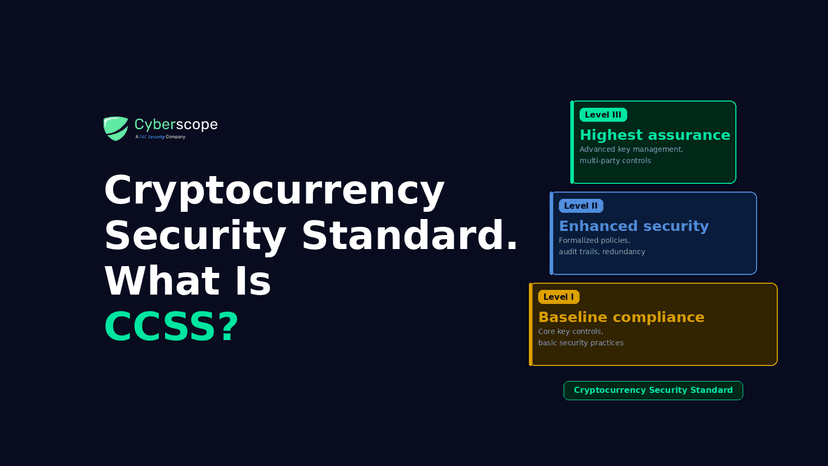
Level I
Level I represents a genuinely solid security baseline. An organization at this level has implemented meaningful controls across key management and operations, has a documented process for handling security incidents, and can demonstrate this through an actual audit rather than just a policy document sitting unused.
Level II
Level II adds meaningfully stronger requirements on top of Level I, generally involving more rigorous verification processes around key usage, such as requiring transaction destinations and amounts to be confirmed through approved communication channels before funds actually move.
Level III
Level III represents the most comprehensive tier, with the strictest requirements around redundancy, authentication, and operational controls. This is the level most appropriate for organizations managing significant value or serving as custodians for other people's funds at real scale.
An important detail that trips people up: an organization's overall CCSS level is determined by its weakest scoring aspect, not an average across all of them. A company could score at Level III on nearly every requirement, but if even one aspect only meets Level I standards, the organization is certified at Level I overall. This weakest link approach is deliberate, since a single poorly secured area, even surrounded by otherwise excellent practices, can still be the point an attacker actually exploits.
How CCSS Certification Actually Works
The Role of the CCSSA
Certification is carried out by a Cryptocurrency Security Standard Auditor, or CCSSA, an individual who has completed C4's official training and passed a dedicated certification exam covering the full set of aspect controls within the standard. This training is intentionally rigorous, since the entire value of certification depends on auditors applying the standard consistently and impartially across different organizations.
Peer Review and Certification
Once a CCSSA completes an audit, their findings go through a peer review process before C4 issues an official Certificate of Compliance. This extra layer exists specifically to prevent inconsistent or overly lenient audits from producing a certification that does not actually reflect genuine security practice, which matters enormously for a credential meant to signal real trust to users and partners.
Common Aspects You Will See Referenced in a CCSS Audit
A handful of specific aspects come up repeatedly across CCSS documentation and audits.
Key and Seed Generation
This covers how cryptographic keys and seeds are actually created, focusing on two requirements: confidentiality during generation, so no unintended party can observe or copy the new key, and genuine unpredictability, so the resulting key cannot be guessed or reconstructed by an attacker.
Wallet Creation
This covers the process used to create wallets themselves, including whether appropriate redundancy and backup procedures are built in from the start rather than added as an afterthought.
Key Storage
This covers how keys are protected once generated, including encryption standards for backups and whether keys are geographically distributed to avoid a single localized event, a fire, a flood, a break-in, from destroying access to funds entirely.
Key Usage
This covers the authentication required before a key is actually used to authorize a transaction. Depending on the certification level, this can mean requiring multiple independent authentication factors, or verifying the actual destination and amount of a transaction through a separate, trusted communication channel before it executes.
Key Compromise Protocol
This covers whether an organization has an actual, tested process for responding if a key or its holder is ever suspected of being compromised, rather than discovering during an active incident that no such plan exists.
Keyholder Grant and Revoke Policies
This covers how access to keys is granted to new personnel and, just as importantly, how quickly and reliably that access gets revoked when someone leaves the organization or changes roles. This is one of the most commonly overlooked areas in practice, and one of the most exploitable when it is neglected.
How CCSS Differs From ISO 27001, SOC 2, and a Smart Contract Audit
It is worth being clear about what CCSS is not. It is not a replacement for general information security frameworks like ISO 27001 or SOC 2, which cover broader practices around network security, physical security, and business continuity that CCSS deliberately does not address. It is meant to sit alongside those frameworks, not instead of them.
It is also a fundamentally different exercise than a smart contract audit. A smart contract audit evaluates the code deployed on-chain for vulnerabilities and logic errors. CCSS evaluates the organizational and operational practices surrounding key management, which is a distinct, though closely related, category of risk. A project can have flawless, audited smart contract code and still suffer a catastrophic loss through a compromised admin key or a poorly managed keyholder offboarding process, exactly the kind of gap CCSS is designed to catch.
Why CCSS Matters for Exchanges, Custodians, and Wallet Providers
Any organization holding cryptocurrency on behalf of others, exchanges, custodians, and wallet providers chief among them, carries an elevated responsibility that goes well beyond writing secure code. Users trusting a platform with their funds have no visibility into how that platform actually manages its keys internally, which is exactly the trust gap CCSS certification is meant to close. A verifiable, independently audited certification gives users, investors, and partners a real signal to evaluate, rather than having to take a company's own claims about its security practices at face value. Our broader guide to web3 security compliance covers how frameworks like this fit into the wider compliance picture alongside KYC and regulatory requirements.
How to Prepare for a CCSS Audit
Preparation for a CCSS audit looks a lot like preparation for any serious security review, just focused specifically on key management and operational policy rather than code. Document your actual key generation and storage processes clearly, rather than relying on informal, undocumented team knowledge. Review your keyholder access policies and confirm that offboarding actually happens promptly and consistently, not just in theory. Test your key compromise response plan before you need it for real, the same way you would test an incident response plan for any other kind of security event. Our guide on cybersecurity best practices for web3 businesses covers several operational habits that overlap directly with what a CCSS audit will be looking for.
How CCSS Complements Cyberscope's Security Services
CCSS certification and a full technical security review genuinely work best together, since they cover different, complementary parts of an organization's overall risk. A smart contract audit confirms your on-chain code is sound. Penetration testing probes your APIs, infrastructure, and any custodial systems for exploitable weaknesses. Real time monitoring catches unusual activity after launch, whether that activity originates from a code level exploit or a compromised key. CCSS certification, alongside this technical work, addresses the organizational and procedural side that none of these technical reviews are actually designed to evaluate on their own. Together, they give a genuinely complete picture of an organization's real security posture, not just the parts that are easiest to test with automated tooling.
Conclusion
CCSS fills a gap that general cybersecurity frameworks were never built to address: the specific, high stakes discipline of managing cryptographic keys and the funds they control. For exchanges, custodians, and any business holding cryptocurrency on behalf of users, understanding and working toward CCSS compliance is not just a credibility exercise. It is a genuine framework for catching exactly the kind of operational gaps, weak key generation, poor offboarding, missing incident response plans, that have caused some of the most damaging losses in the industry's history, none of which a smart contract audit alone would ever catch.
Recent Posts
Cryptocurrency Security Standard: What Is CCSS?
2 months ago
Blockchain and Web3 Incident Response
2 months ago