

Understanding and Preventing Front-Running Attacks

CyberScope
Aug 07, 2026
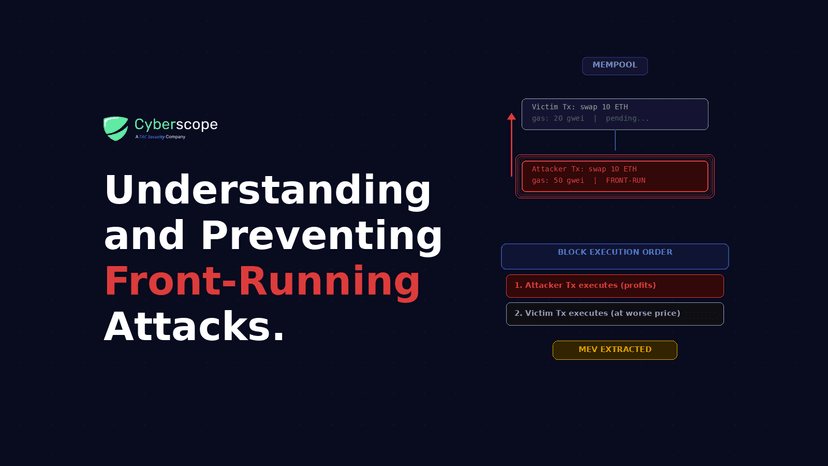
What Is a Front-Running Attack?
A front-running attack happens when someone sees a pending transaction before it gets confirmed and jumps ahead of it by submitting their own transaction with a higher fee, getting it processed first and profiting from advance knowledge of what is about to happen. In traditional finance, this kind of thing is illegal and heavily policed. In crypto, the mechanics that make it possible are built directly into how public blockchains work, which makes front-running less of a rare exploit and more of an ongoing, structural feature of the ecosystem that anyone interacting with DeFi needs to actually understand.
This is not a theoretical risk. Front-running and its close relatives cost users real money every single day across decentralized exchanges, and the bots running these strategies operate constantly, watching for exactly the kind of pending transaction that creates an opportunity.
Why Front-Running Is Possible on Public Blockchains
The Mempool Is Public
Before a transaction gets confirmed, it sits in a mempool, a public waiting area visible to anyone running a node. This is fundamentally different from traditional finance, where an order sitting with a broker is not visible to competitors before it executes. On most blockchains, anyone, including automated bots built specifically for this purpose, can see exactly what you are about to do before it actually happens.
Miners and Validators Choose Transaction Order
Transactions do not get processed strictly in the order they arrive. Miners and validators generally prioritize transactions offering higher fees, which means anyone willing to pay more can effectively jump the queue. Combine this with a visible mempool, and you get a genuine race condition built into the system: whoever spots a profitable opportunity fastest and pays the highest fee to act on it wins, regardless of who submitted their transaction first. Our explainer on how consensus works in blockchain covers the underlying mechanics of how transaction ordering actually gets decided.
Types of Front-Running Attacks
Classic Front-Running
The simplest version. A bot spots a profitable pending transaction, submits an identical or similar transaction with a higher gas fee, and gets it confirmed first, capturing the opportunity before the original transaction even executes.
Sandwich Attacks
This is the version most DeFi users actually run into. A bot spots a large pending swap on a decentralized exchange, places a buy order immediately before it, letting the victim's trade push the price up further, then immediately sells right after the victim's transaction confirms, pocketing the difference. The victim's own trade is what moves the price in the attacker's favor, sandwiched directly between the attacker's two transactions.
Back-Running
Rather than jumping ahead of a transaction, a back-running bot submits its own transaction immediately after a target transaction confirms, capitalizing on the state change that transaction just caused. This is common around large trades, liquidations, or oracle price updates, where the moment right after an event creates a predictable, exploitable opportunity.
Generalized Front-Running
Some bots do not bother analyzing what a pending transaction actually does. Instead, they simply detect that a transaction is profitable, often by simulating it against current chain state, then copy it wholesale with a higher gas fee, effectively stealing the strategy without needing to understand it. This has made publishing genuinely novel arbitrage or liquidation strategies on-chain a real strategic risk in its own right.
A Simplified Example
Imagine a user submits a transaction to buy a large amount of a token on a decentralized exchange, a trade big enough to noticeably move the price. A front-running bot watching the mempool sees this pending transaction, calculates that the trade will push the price up, and immediately submits its own buy order with a higher gas fee. That bot's transaction confirms first, buying the token at the current, lower price. The original user's trade then executes, pushing the price up further and confirming the bot's prediction. The bot immediately sells, having bought low, watched someone else's trade push the price higher, and sold into that exact price movement, all within the same few blocks, all triggered purely by seeing a pending transaction before it happened.
Real World Impact: MEV and Its Consequences
This entire category of activity falls under a broader term called MEV, or maximal extractable value, referring to the profit that can be extracted by reordering, inserting, or excluding transactions within a block. MEV is not inherently malicious in every form, some of it comes from legitimate arbitrage that actually helps keep prices consistent across markets, but front-running and sandwich attacks represent its most directly harmful expression, extracting value straight from ordinary users trying to execute a normal trade.
The scale of this is genuinely significant. Sandwich attacks alone have extracted enormous sums from DeFi users over the years, often in amounts small enough per transaction that individual victims barely notice, which is exactly what makes it such a persistent and underreported problem. Flash loans have made certain front-running and sandwich strategies even more accessible, letting an attacker access large amounts of capital for a single block without needing to hold it themselves, lowering the barrier to running these strategies at scale.
How to Prevent Front-Running Attacks
Use Commit-Reveal Schemes
A commit-reveal pattern splits an action into two separate steps. First, a user submits a hashed commitment to an action without revealing its actual details. Later, once that commitment is locked in, they reveal the actual transaction details, which the contract can then verify against the original commitment. Because the meaningful details are hidden during the vulnerable window, there is nothing for a bot to front-run in the first place.
Set Slippage Tolerance and Minimum Output Amounts
For everyday users, the simplest defense against sandwich attacks is setting a reasonable slippage tolerance and minimum output amount on trades. If a sandwich attack would push your actual received amount below that minimum, the transaction simply fails rather than executing at a manipulated price. This does not stop the attack from being attempted, but it stops it from actually costing you money.
Use Private Transaction Pools or MEV-Protected Relays
Several services now let users submit transactions through private channels that bypass the public mempool entirely, sending transactions directly to block producers rather than broadcasting them publicly first. This removes the visibility that front-running bots depend on, since there is nothing sitting in a public queue for them to react to.
Design Contracts With MEV in Mind
Developers building DeFi protocols can reduce front-running exposure through careful design choices, batching transactions together, using time-weighted average pricing instead of instant spot prices for sensitive calculations, or introducing randomized ordering within a batch rather than relying purely on gas price priority. Our guide on gas optimization audits touches on related considerations around how transaction costs and ordering interact with contract design.
Time-Weighted or Batch Auctions
Rather than executing trades instantly and sequentially, some protocols batch multiple orders together and settle them at a single, uniform price determined after the batch closes. This structurally removes the advantage of seeing an individual pending transaction, since no single trade executes in isolation for a bot to react to.
What Founders and Developers Should Actually Do
If you are building a DeFi protocol, treat MEV and front-running exposure as a genuine design consideration from the start, not an afterthought discovered after users start complaining about unexpectedly bad trade execution. This means thinking through how your contract's functions could be exploited by transaction ordering manipulation during the design phase, not just checking for it reactively once the code is written. A proper smart contract audit should explicitly evaluate MEV exposure alongside more traditional vulnerability classes, and our overview of common smart contract vulnerabilities is a useful companion resource for understanding how front-running risk tends to interact with other weaknesses in a contract's design.
If you are a user, the practical defense is simpler: always set a real slippage tolerance rather than leaving it at a default that allows unlimited price movement, and consider routing sensitive trades through a private transaction relay when the trade size is large enough to be worth protecting.
How Cyberscope Helps Identify Front-Running Risk
A thorough smart contract audit reviews not just traditional vulnerability classes but also how a contract's functions behave under adversarial transaction ordering, tracing through scenarios where a malicious actor manipulates the sequence of calls around a user's transaction to extract value. This kind of review often benefits from combining black box and white box testing, simulating how an external attacker would actually behave against the deployed contract, alongside a direct review of the underlying code. For protocols where MEV exposure carries particularly high stakes, formal verification can help confirm that specific invariants, like guaranteed minimum output amounts, hold even under adversarial reordering. Once live, real time monitoring can also flag unusual patterns consistent with active sandwich or front-running activity targeting a protocol's users, giving a team real visibility into how much value their users are actually losing to this kind of activity over time.
Conclusion
Front-running is not a bug in the traditional sense. It is a direct consequence of how public blockchains order transactions, and it is not going away simply because more people become aware of it. What changes outcomes is deliberate design, commit-reveal patterns, batch auctions, MEV-aware contract architecture, on the protocol side, and sensible slippage settings paired with private transaction relays on the user side. Treating this as a real, ongoing consideration rather than an occasional annoyance is what separates protocols that genuinely protect their users from the ones quietly losing them value on every single trade.
Recent Posts
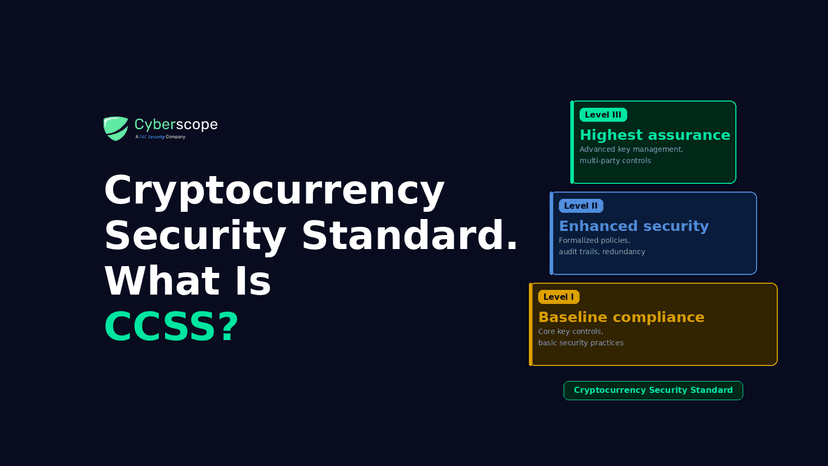
Cryptocurrency Security Standard: What Is CCSS?
2 months ago
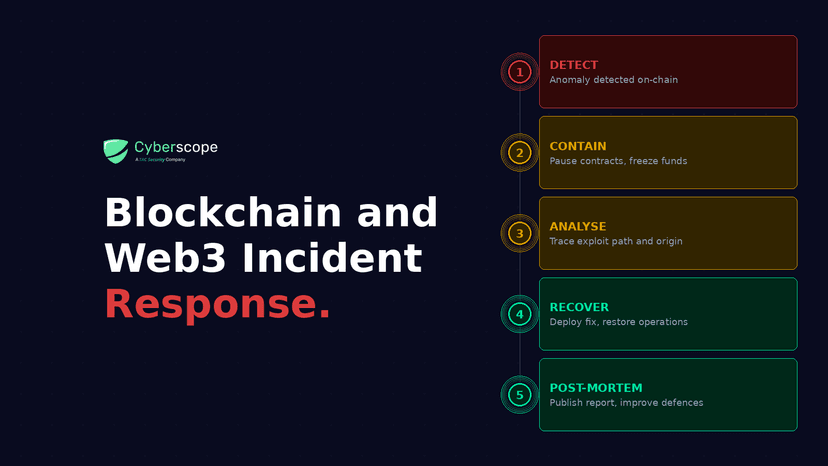
Blockchain and Web3 Incident Response
2 months ago