
Blockchain and Web3 Incident Response

CyberScope
Aug 07, 2026
What Incident Response Actually Means in Web3
Incident response is the structured process a team follows when something has gone wrong, an exploit, a compromised key, a bridge failure, and needs to respond quickly, correctly, and without making the situation worse through panic or poor coordination. In traditional IT, this discipline is well established, with playbooks, dedicated teams, and decades of shared experience behind it. Web3 has had to build its own version of this from scratch, and it has had to do it under conditions that are genuinely harsher than almost anything traditional security teams deal with.
A security incident in crypto is rarely quiet. Funds move in seconds, the entire event is visible on-chain to anyone watching, and the window between something going wrong and it becoming irreversible is often measured in minutes, not the hours or days a traditional breach response might allow for. Having a real plan before that moment arrives is the difference between a contained incident and a total loss.
Why Web3 Incident Response Is Different From Traditional IT
Transactions Are Irreversible
In conventional finance, a fraudulent transaction can often be flagged, frozen, or reversed by the institutions involved. On most blockchains, once a transaction confirms, it is final. There is no chargeback, no customer service line to call, no bank that can claw the funds back on your behalf. This single fact reshapes the entire discipline. Prevention and speed of containment matter far more than they do in a system where mistakes can be undone after the fact.
The Clock Moves in Minutes, Not Days
A traditional data breach might unfold over weeks before anyone notices unusual activity. A smart contract exploit can drain a protocol's entire treasury in a single transaction, sometimes before the team even knows an attack is underway. This compresses every phase of incident response into a fraction of the time a traditional security team would normally have, which is exactly why preparation before an incident matters so much more here than reacting well after one starts.
Everything Is Public
Every transaction, every wallet interaction, every contract call is sitting on a public ledger the moment it happens. This cuts both ways. It means responders often have far more visibility into an ongoing attack than a traditional security team would during a conventional breach, but it also means the entire community, including the attacker, is watching the response unfold in real time. There is no quiet, behind closed doors remediation period. Whatever you do next happens in public.
Common Types of Web3 Security Incidents
Smart Contract Exploits
The most familiar category, where an attacker identifies and exploits a vulnerability in a contract's logic, reentrancy, access control gaps, flawed arithmetic, to drain funds or manipulate the contract's behavior. Our guide on common smart contract vulnerabilities covers the patterns that show up most often in real incidents.
Private Key and Admin Compromise
Sometimes the code is fine and the actual weak point is operational. A compromised private key, a phished team member, or a poorly secured admin wallet can hand an attacker direct control over a contract or its funds without needing to find a single bug in the code itself.
Bridge and Cross-Chain Failures
Cross-chain bridges remain some of the highest value, highest risk targets in the entire industry, since they concentrate enormous liquidity in a single point of failure while also inheriting the combined attack surface of every chain they connect.
Governance Attacks
Projects governed by DAOs or token voting mechanisms face a different kind of risk entirely, where an attacker acquires enough voting power, whether through a flash loan or accumulated tokens, to push through a malicious proposal that grants them direct control over a treasury or protocol parameters.
Front-End and Off-Chain Compromise
Not every incident originates on-chain. A compromised front-end, a hijacked DNS record, or a fake update pushed through a project's official website can trick users into signing malicious transactions while believing they are interacting with the legitimate protocol. From the user's perspective, the contract itself might be flawless, and the actual point of failure sits entirely outside it.
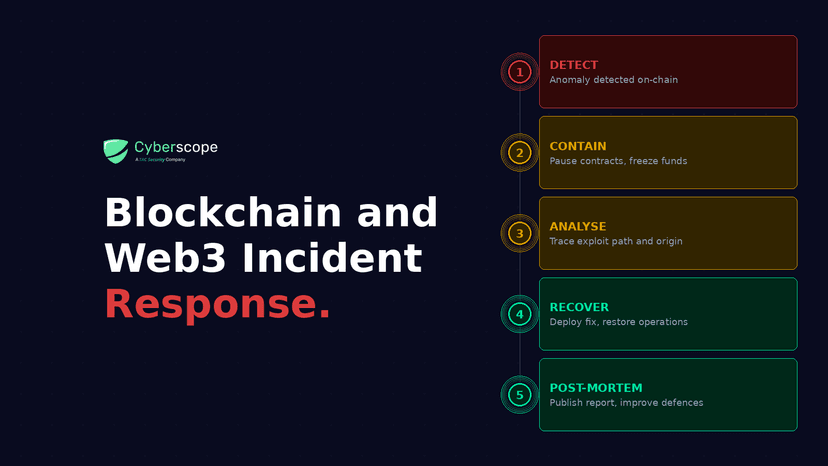
The Phases of a Web3 Incident Response Plan
Preparation
This is where the real work happens, long before anything goes wrong. It includes defining roles and responsibilities, setting up monitoring, securing admin keys properly, and having emergency mechanisms, like a pause function, already built into the contract and tested, not designed on the fly during an actual attack.
Detection
Speed here is everything. The faster an incident is detected, the more options remain available for containment. Real time monitoring that flags unusual transaction volumes, abnormal function calls, or suspicious wallet behavior is what turns detection from something that happens hours later, after community members start asking questions on social media, into something that happens within minutes of the first suspicious transaction.
Containment
Once an incident is confirmed, the priority shifts to stopping further damage. This might mean triggering a pause function if one exists, coordinating with exchanges to flag and freeze stolen funds as they move, or alerting other protocols the attacker's wallet might interact with next. Every minute spent deciding what to do rather than actually doing it costs real money at this stage.
Eradication and Remediation
With the immediate bleeding stopped, the team needs to actually understand what happened well enough to close the vulnerability permanently, not just patch the specific transaction that triggered the incident. This usually requires a focused security review of the exploited code path, and often the broader codebase around it, since attackers frequently probe for multiple weaknesses before settling on the one they actually use.
Recovery
This phase covers restoring normal operations, redeploying fixed contracts if necessary, and, where possible, working toward recovering or compensating for lost funds. Recovery efforts vary enormously in outcome. Some incidents end with a negotiated return of funds through a whitehat arrangement. Many do not, which is exactly why prevention remains far more valuable than any recovery plan.
Post-Incident Review
Once the immediate crisis has passed, a genuine post-mortem matters, not as a formality, but as the step that actually prevents a repeat. This means documenting exactly what happened, why existing defenses did not catch it, and what specific changes, technical and procedural, need to happen before this can happen again. Our guide on how often smart contracts should be audited is relevant here, since a post-incident review often reveals that a review cadence was simply too infrequent for how quickly the protocol had evolved.
Building an Incident Response Plan Before You Need One
Know Who Holds the Keys
Every team should know, with total clarity, who holds admin access, how many signatures a multisig requires, and how quickly those key holders can actually be reached in an emergency. A plan that assumes everyone will be instantly available at 3am is not a real plan.
Have a Pause Mechanism, and Know How to Use It
A pause function built into a contract is only useful if the team knows exactly how to trigger it under pressure, has tested that process beforehand, and has already thought through the tradeoffs of pausing, since halting a protocol can itself cause user panic and knock-on effects that need to be managed alongside the original incident.
Prepare Your Communication Plan in Advance
What you say publicly during an active incident matters enormously, and figuring it out in real time under pressure tends to go badly. Draft communication templates ahead of time, know who is authorized to speak on behalf of the project, and decide in advance how much detail gets shared while an investigation is still ongoing.
Establish Relationships With Auditors and Investigators Beforehand
Trying to find and vet a security firm for the first time while actively under attack is a genuinely bad position to be in. Our guide on choosing a blockchain audit firm is worth reading well before you need emergency support, so that if an incident does happen, you are calling a firm you already trust rather than researching options from scratch under pressure.
The Role of On-Chain Forensics and Whitehat Negotiation
Because blockchain activity is public, tracing stolen funds is often technically possible even when recovering them is not guaranteed. On-chain forensics involves following an attacker's wallet across transactions, identifying exchange deposits where funds might be frozen, and building a clear picture of the attack's mechanics for both technical remediation and, where relevant, law enforcement involvement. In some cases, projects have successfully negotiated with attackers directly, offering a bounty in exchange for returning the bulk of stolen funds, essentially treating the incident as an unsanctioned but real bug bounty after the fact. This approach does not always work, and it should never be the primary plan, but it has recovered meaningful funds in several well documented cases. Our guide for victims of a crypto scam covers what practical steps are available on the user side of this same problem.
How Monitoring Changes the Outcome of an Incident
The single biggest variable separating a contained incident from a catastrophic one is almost always detection speed. Protocols with genuine real time monitoring in place catch abnormal activity within minutes, often before an attacker has finished draining what they came for, giving the team a real chance to pause the contract, alert exchanges, or otherwise limit the damage. Protocols without it tend to find out from a community member on social media, often hours after the exploit started, by which point most of the available response options have already closed. Pairing that monitoring with a completed smart contract audit and periodic penetration testing of surrounding infrastructure gives a project both fewer incidents to respond to in the first place and a genuinely faster response when something does slip through. Our roundup of the biggest cryptocurrency hacks of all time makes this pattern clear across nearly every major incident in the industry's history.
Conclusion
Web3 incident response is not optional infrastructure for serious projects. It is a core part of operating responsibly in an environment where mistakes are public, fast moving, and often permanent. The teams that fare best when something goes wrong are, almost without exception, the ones who built their response plan before they ever needed it, with clear roles, tested emergency mechanisms, real monitoring already in place, and relationships with security partners established well ahead of any crisis. Waiting until an incident is underway to figure any of this out is how a contained problem turns into a catastrophic one.