What Is Formal Verification in Smart Contract Auditing?

CyberScope
Jul 30, 2026
Why This Question Comes Up So Often
Anyone who has read through a smart contract audit report has probably run into the term formal verification tucked somewhere near the top, usually listed alongside manual review and automated tooling as part of the overall methodology. Most people skim past it without really understanding what it means, which is fair, since it sounds like something borrowed from an academic paper rather than a practical security technique. In a way, it is exactly that. Formal verification comes out of decades of research in computer science, and it has quietly become one of the more powerful tools available for proving that a smart contract actually does what it is supposed to do, mathematically, rather than just probably.
This matters more in smart contracts than almost anywhere else in software. Once a contract is deployed, its logic is public, permanent, and directly tied to real money. There is no patch Tuesday, no quiet server side fix. A flaw sitting in the code is available for anyone to find and exploit the moment it goes live, which is exactly why teams increasingly reach for something stronger than a human reading through the code line by line.
What Formal Verification Actually Means
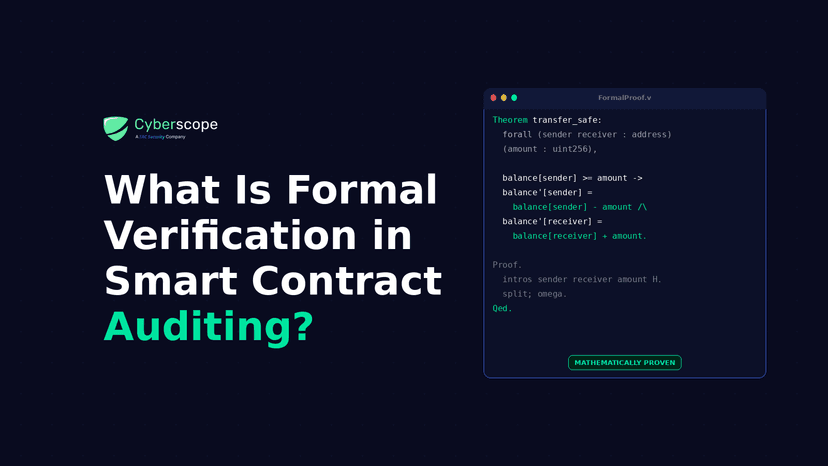
At its core, formal verification is a mathematical method for proving that a piece of code behaves exactly as intended, under every possible input and every possible execution path, not just the ones a tester happened to think of. Instead of running the code and observing what happens, formal verification treats the code as a mathematical object and proves properties about it directly, the same way a mathematician proves a theorem rather than testing it against a handful of examples.
This distinction is the whole point. Traditional testing can only ever show that a piece of code behaves correctly for the specific cases you tested. It can never prove the absence of a bug, only the presence of the bugs you happened to look for. Formal verification flips that. Done properly, it can prove that a defined property holds across the entire space of possible inputs and states, which is a fundamentally stronger guarantee than even the most exhaustive manual review can offer on its own.
How Formal Verification Differs From a Standard Audit
A thorough smart contract audit usually layers several distinct techniques together, and it helps to understand where formal verification actually fits among them.
Manual Review
This is the foundation of any real audit. An experienced auditor reads through the code line by line, understanding intent, tracing logic, and applying pattern recognition built from having seen hundreds of contracts before. It catches business logic flaws and contextual issues that automated tools genuinely struggle with, but it is still fundamentally limited by human attention and time. Our guide on black box versus white box testing covers how manual review typically combines both perspectives to get a fuller picture.
Automated Static Analysis
Static analysis tools scan code for known vulnerability patterns automatically, reentrancy signatures, unchecked external calls, common integer handling mistakes, and more. These tools are fast and genuinely useful for catching the low hanging fruit, but they work off pattern matching against known issue types. Anything outside those known patterns tends to slip through untouched.
Formal Verification
Formal verification sits above both of these. Rather than reading code for familiar red flags or checking specific test cases, it mathematically proves that a defined property holds true across the contract's entire possible state space. It does not replace manual review or static analysis. It adds a layer neither of those techniques can fully replicate on their own, which is exactly why the strongest audits combine all three rather than relying on any single approach.
How Formal Verification Actually Works
Writing a Formal Specification
The process starts by defining, in precise mathematical terms, what the contract is actually supposed to guarantee. This might be something like total token supply never increasing beyond a defined cap, a user's balance never going negative, or a specific function only ever being callable by an authorized address. These properties get written in a formal specification language, distinct from the contract's actual implementation code, describing what correct behavior looks like rather than how it is achieved.
Modeling the Contract
Next, the actual contract code gets translated into a mathematical model that a verification tool can reason about. This step is genuinely technical and requires real expertise, since an inaccurate model produces a proof that does not actually correspond to the real deployed code, which would defeat the entire purpose.
Proving the Properties
With both the specification and the model in place, a verification tool, often built around SMT solvers or theorem proving techniques, attempts to mathematically prove that the model satisfies every defined property under all possible conditions. If a property cannot be proven, the tool typically produces a counterexample, a specific scenario where the property fails, giving developers exactly the information they need to fix the underlying issue.
What Formal Verification Can and Cannot Catch
Formal verification is extremely good at proving properties that can be stated precisely and mathematically. Things like arithmetic overflow protection, invariants around token supply, access control guarantees, and specific safety properties around fund custody are all well suited to this kind of proof.
Where it struggles is with anything that cannot be cleanly expressed as a formal property in the first place. If a contract's business logic is simply wrong, say a reward calculation that technically executes exactly as coded but reflects a flawed economic assumption, formal verification will happily prove that the flawed logic behaves consistently, since consistency is not the same thing as correctness in a business sense. This is exactly why formal verification complements manual review rather than replacing it. A human auditor catches the flawed intent behind the code; formal methods prove the implementation matches whatever intent was actually specified. Our overview of common smart contract vulnerabilities is a good reference for the kinds of issues that tend to require this combined approach rather than one technique alone.
When Formal Verification Is Worth the Investment
Formal verification takes real time and genuine expertise, which means it is not always the right tool for every project. It tends to make the most sense for contracts where a single bug carries outsized consequences: large DeFi protocols managing significant total value locked, stablecoin issuance and redemption logic, cross chain bridges reconciling state across multiple networks, and any contract handling custody of user funds at scale. A simple NFT minting contract with modest value at stake rarely needs the same level of mathematical rigor as a lending protocol holding hundreds of millions in deposits, though it can still benefit from a standard audit and reasonable penetration testing of any surrounding infrastructure.
Common Techniques and Tools Used in Formal Verification
A handful of approaches show up repeatedly across the formal verification landscape. Model checking exhaustively explores a system's possible states looking for violations of defined properties. Theorem proving uses interactive or automated logical deduction to construct a full mathematical proof that a property holds. SMT, or satisfiability modulo theories, solvers underpin much of the automated reasoning behind modern formal verification tools, checking whether a set of mathematical constraints can be satisfied, which maps naturally onto proving or disproving properties about contract behavior. Different ecosystems have developed their own tooling around these techniques, and the specific approach used often depends on which chain and language a contract is written in, whether that is Solidity on Ethereum or Rust based programs on ecosystems like Solana.
Formal Verification in Practice: A Simple Example
Consider a basic token contract with a fixed maximum supply. A formal specification for this contract might state that the total supply variable should never exceed that fixed cap, under any sequence of mint and burn operations, no matter how many transactions occur or in what order. A verification tool would attempt to mathematically prove this holds across every possible execution path through the contract's minting logic. If there is some edge case, say a specific ordering of operations that allows supply to briefly exceed the cap due to a rounding error or an unchecked arithmetic operation, formal verification would surface that exact scenario as a counterexample, something that traditional testing might easily miss if nobody happened to write a test case for that specific sequence.
Limitations of Formal Verification
Formal verification is not a silver bullet, and it is worth being honest about its real constraints. It requires genuinely specialized expertise, both in writing accurate specifications and in modeling contracts correctly, which makes it more resource intensive than manual review or automated scanning alone. It also depends entirely on the specification being correct and complete. A formally verified contract that satisfies an incomplete or poorly written specification can still contain serious vulnerabilities the specification simply never accounted for in the first place. And it works best on self contained logic. Contracts with heavy external dependencies, complex interactions with off-chain systems, or reliance on external price oracles introduce elements that are considerably harder to formally model with the same level of rigor.
How Cyberscope Approaches Formal Verification
At Cyberscope, formal verification is applied as a targeted layer on top of a full smart contract audit, reserved specifically for the properties and functions where a mathematical guarantee genuinely matters, rather than treated as a blanket requirement for every line of code. This typically means identifying the highest risk components of a contract, fund custody logic, minting and burning mechanics, and critical access controls, and proving those specific properties hold rather than attempting to formally verify an entire codebase indiscriminately, which is rarely a practical use of time or budget. This applies across ecosystems, whether the contract in question sits on Ethereum or a Rust based chain like Solana. Once a contract is live, ongoing real time monitoring picks up where any point in time verification leaves off, watching for behavior that falls outside expected parameters after deployment.
Conclusion
Formal verification brings a genuinely different kind of confidence to smart contract security, moving beyond testing a handful of scenarios toward mathematically proving that specific properties hold across every possible input and state. It is not a replacement for manual review, automated tooling, or careful preparation before an audit even begins, but layered alongside those techniques, it catches a category of subtle, high consequence bugs that would otherwise be extremely easy to miss. For any project where a single flaw could mean a significant loss of funds, it is one of the more meaningful investments available in getting the underlying logic genuinely right before real money depends on it.