How Founders Should Approach Web3 Security

CyberScope
Jul 30, 2026
Why Security Has to Be a Founder's Problem, Not Just an Engineer's
It is tempting, as a founder, to treat security as something you hire for and then stop thinking about. Bring on a solid engineering team, budget for an audit near the end, and trust that the technical side of the house has it handled. That instinct is understandable, but it is also exactly how a lot of otherwise promising projects end up as case studies in what went wrong.
Security decisions in Web3 are not purely technical. They are business decisions with technical implementation. How much runway you allocate to testing before launch, whether you rush a feature out to hit a marketing deadline, how much authority a single admin key holds over your treasury, these are choices a founder makes, whether consciously or by default, and every one of them shapes your actual risk exposure far more than most people realize. Engineers can build secure code. Only a founder can decide whether the business is actually structured to prioritize that security when it matters most.
Building Security Into Your Timeline From Day One
Budget for Security Before You Budget for Marketing
This ordering matters more than it sounds like it should. Plenty of founders plan a launch budget that covers a marketing push, an influencer campaign, a listing fee, and then treat security spend as whatever is left over. Flip that thinking. A smart contract audit is not an optional add-on competing with your marketing budget. It is closer to a cost of doing business at all, the same way you would not skip legal review of a major contract to save money for advertising. Our breakdown of what a smart contract audit actually costs is worth reading early, specifically so this number is baked into your fundraising and budgeting from the start rather than discovered as a surprise a month before launch.
Treat Security as a Development Milestone, Not a Launch Day Checkbox
The founders who handle this well build security checkpoints into their actual product roadmap, not just their launch checklist. That means planning for an audit with enough lead time to actually fix what comes back, not scheduling it the week before a token generation event and hoping for a clean report. It also means thinking about security incrementally as features ship, rather than treating it as one giant review that happens once, right before everything goes live. Our step by step guide on how to audit your dApp is a useful reference for what this actually looks like in practice, from a founder's perspective as much as an engineer's.
What Founders Actually Need to Understand, Without Becoming Engineers
You do not need to read Solidity to make good security decisions. You do need a working mental model of what is actually being protected against, and where the real gaps tend to show up.
Know What a Smart Contract Audit Actually Covers
An audit reviews your code for vulnerabilities, logic errors, and deviations from best practice. It does not evaluate whether your tokenomics make sense, whether your business model is sustainable, or whether your team is trustworthy. Founders sometimes treat a clean audit as a blanket signal of project health, and that is a mistake. It is a signal that your code, as reviewed, did not contain the vulnerabilities the auditors were looking for at that point in time. That is valuable, but it is narrower than most people assume. If your economics need a second look, our guide on tokenomics design principles covers a separate but equally important piece of the puzzle.
Understand the Difference Between a One Time Audit and Ongoing Security
A single audit report reflects the code as it existed on a specific date. It says nothing about what happens after you ship an upgrade, add a new feature, or integrate with a new external protocol. Founders who treat one audit as a permanent stamp of safety are setting themselves up for exactly the kind of incident that makes headlines. Our guide on how often smart contracts should actually be audited covers why this needs to be an ongoing relationship rather than a single transaction, and real time monitoring exists specifically to cover the gap between audits, catching unusual activity the moment it happens rather than weeks later.
Recognize That Compliance and Security and Are Not the Same Thing
Passing KYC checks, meeting MiCA compliance requirements, and having a security audit are three genuinely different things, and founders sometimes conflate them into a single vague sense of being covered. You can be fully compliant with every applicable regulation and still have an exploitable bug sitting in your contract, and you can have flawless code while being completely unprepared for the regulatory questions that come with operating in multiple jurisdictions. Our complete guide to web3 security compliance and our breakdown of KYC versus AML in crypto both cover ground that a security audit simply does not touch.
Common Mistakes Founders Make
Treating the Audit Badge as Marketing Rather Than Substance
An audit badge genuinely helps with credibility, and there is nothing wrong with using it that way. The mistake is treating the badge itself as the goal, rather than the actual security work behind it. Our guide on getting an audit badge on CoinMarketCap is useful once you have done the real work, but chasing the badge without genuinely fixing what an audit finds defeats the entire purpose and tends to be obvious to anyone who actually reads the underlying report.
Rushing the Timeline to Hit a Launch Date
This is probably the single most common founder mistake in the space. A launch date gets set early, often for reasons that have nothing to do with engineering readiness, marketing momentum, an exchange listing window, investor pressure, and everything downstream gets compressed to fit it. Security review is almost always the first thing to get squeezed when a timeline is under pressure, which is exactly backward. If your timeline and your security needs are in genuine conflict, move the launch date. Nearly every serious incident post-mortem includes some version of we knew we were rushing.
Underestimating Off-Chain Risk
Founders tend to focus heavily on smart contract code, since that is the part everyone talks about, and underinvest in everything surrounding it. APIs, custodial key management, admin panels, and any bridge connecting your project to another chain all carry real risk that a smart contract audit alone will not catch. Penetration testing exists specifically to cover this broader surface area, and it deserves the same seriousness as your on-chain code review, not an afterthought squeezed in if there is budget left over.
Ignoring Team and Operational Security
Some of the most damaging incidents in this space have had nothing to do with a bug in the code at all. Compromised admin keys, phishing attacks against team members, and social engineering targeting whoever holds deployment privileges have all led to real losses at otherwise well built projects. Basic operational hygiene, multisig wallets for anything with real authority, hardware security keys for team accounts, and a genuine incident response plan, matters just as much as the quality of your contract code, and it costs far less to get right.
Building a Security Roadmap as You Scale
Pre-Launch
This is where a full smart contract audit happens, with enough buffer built in to actually remediate findings rather than shipping with known issues unresolved. It is also the point to lock down operational security: multisig configurations, key management policies, and a clear internal owner for security related decisions.
Launch
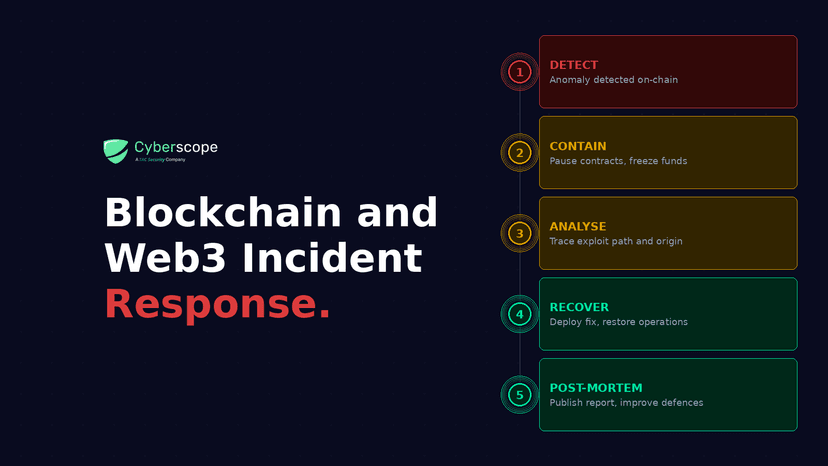
Real time monitoring should already be running before your first real transaction, not set up reactively after something looks wrong. This is also the moment to have an incident response plan actually written down, not improvised under pressure if something does go wrong.
Post-Launch
Every meaningful upgrade or new feature deserves its own review, scaled to the actual risk it introduces rather than treated as a formality. Ongoing monitoring should continue indefinitely, and periodic reassessment, particularly after any significant change to your contract logic or economic model, should be a standing line item in your roadmap rather than something you get around to eventually.
How to Choose the Right Security Partner
Look for a firm with genuine, verifiable experience in your specific chain and language, not just a broad claim of blockchain expertise. Ask to see past reports, not just client logos. A good partner will tell you honestly if your timeline is unrealistic rather than simply agreeing to whatever schedule gets you to launch fastest. Our guide on choosing a blockchain audit firm covers this decision in more depth, and it is worth reading before you sign with the first firm that responds to your outreach.
What Good Security Actually Buys You
Security done properly is not just about avoiding a catastrophic hack, though that alone justifies the investment. It is also a genuine competitive advantage. Investors increasingly ask pointed questions about audit history and ongoing security practices before committing capital. Users, particularly the ones with real capital at stake, have gotten more sophisticated about checking these things themselves before depositing funds. A track record of taking security seriously, verifiable through real audits and a public commitment to understanding common vulnerabilities before they become incidents, tends to compound over time in a way that is genuinely hard to fake with marketing alone.
Conclusion
Founders do not need to become security engineers, but they do need to own security as a genuine business priority rather than delegating it entirely and hoping it gets handled. That means budgeting for it honestly, building it into your actual timeline rather than compressing it under launch pressure, understanding what an audit does and does not cover, and treating security as an ongoing relationship rather than a one time transaction before launch. The projects that survive long enough to matter are, almost without exception, the ones whose founders treated this as their responsibility from the very beginning, not something they outsourced entirely and checked back on once.