
Agentic Wallets Explained: Security Risks and Best Practices

CyberScope
Aug 07, 2026
What Is an Agentic Wallet?
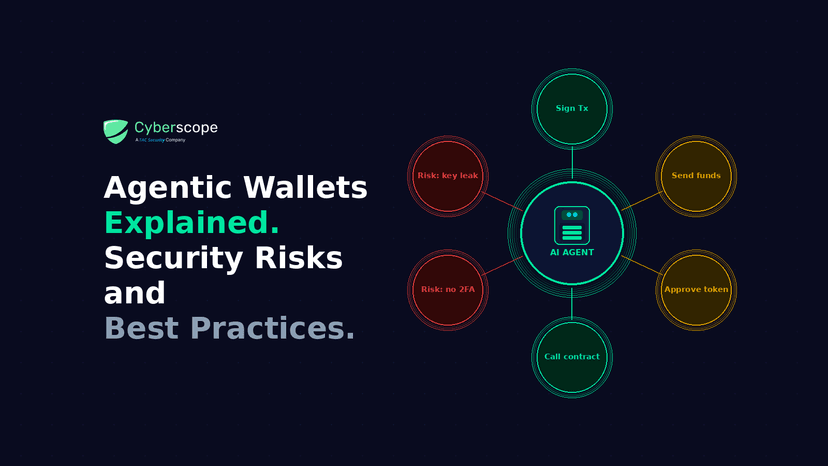
An agentic wallet is a crypto wallet designed to be controlled, at least partially, by an autonomous AI agent rather than a human clicking confirm on every single transaction. Instead of a person manually approving each transfer, swap, or contract interaction, the wallet grants an AI system enough authority to act on its own within a defined set of rules, executing trades, managing liquidity positions, paying for API calls, or interacting with other protocols without waiting for a human to sign off on every step.
This is a genuinely different model from anything crypto security has had to account for before. A traditional wallet assumes a human is the final decision maker before value ever moves. An agentic wallet assumes the AI itself is that decision maker, at least within whatever boundaries it has been given, and that shift changes the entire threat model in ways a lot of teams building with this technology have not fully thought through yet.
Why Agentic Wallets Are Suddenly Everywhere
The rise of agentic wallets tracks almost directly with the broader rise of autonomous AI agents capable of using tools, calling APIs, and executing multi-step tasks without constant supervision. Once an agent can browse, reason, and take action, giving it the ability to actually pay for things, or manage a portfolio, or settle a transaction on someone's behalf, is the natural next step. DeFi in particular has embraced this quickly, with agents managing yield strategies, executing arbitrage, or rebalancing positions faster than any human could reasonably keep up with manually.
The appeal is obvious. Speed, round the clock operation, and the ability to react to on-chain conditions the moment they change rather than whenever a human happens to be watching. The risk is just as real, and it tends to get far less attention than the capability itself.
How Agentic Wallets Actually Work
Delegated Signing and Session Keys
Most agentic wallet architectures avoid handing an AI agent a raw private key outright, for reasons that should be obvious once you think about it for more than a few seconds. Instead, they typically rely on session keys or delegated signing authority, a scoped, often time limited credential that lets the agent sign specific kinds of transactions without ever having access to the wallet's actual master key. If a Web3 wallet is the foundation here, a session key is essentially a narrower, disposable permission layered on top of it.
Spending Limits and Policy Engines
Responsible implementations pair delegated signing with a policy engine, a set of rules defining exactly what the agent is and is not allowed to do. This might cap total spend per day, restrict transactions to a specific list of approved contracts, or require a human to approve anything above a defined threshold. The policy engine is really the entire security model in practice, since it is the thing standing between an agent's autonomous decision and an actual transaction hitting the chain.
On-Chain vs Off-Chain Agent Logic
Some agentic wallets enforce their rules on-chain, through smart contract logic that rejects any transaction violating the defined policy regardless of what the agent tries to do. Others rely on off-chain enforcement, trusting the agent's own software environment to respect its limits before ever constructing a transaction. The distinction matters enormously for security. On-chain enforcement means the rules hold even if the agent itself is compromised or behaves unexpectedly. Off-chain enforcement means the rules are only as strong as the software running the agent, which is a meaningfully weaker guarantee.
What Makes Agentic Wallets a Genuinely New Risk Category
The Agent Itself Becomes an Attack Surface
A traditional smart contract has a fixed, auditable set of functions. An AI agent interpreting natural language instructions, reasoning about goals, and deciding how to act introduces an entirely new layer that did not exist in earlier wallet designs. That layer can be manipulated in ways contract code simply cannot be, through the inputs and instructions the agent receives rather than through the code itself.
Prompt Injection Can Translate Into Real Fund Loss
This is the risk that genuinely sets agentic wallets apart from anything before them. If an agent reads content from an external source, a webpage, a document, another agent's output, and that content contains hidden instructions designed to manipulate its behavior, the agent can potentially be tricked into taking actions its actual owner never intended. In a normal software context, this kind of manipulation might leak data or cause a malfunction. In an agentic wallet context, it can directly authorize a transaction moving real funds. This is not a theoretical concern. It is one of the most actively discussed risks in agentic AI security broadly, and crypto raises the stakes considerably by putting actual money directly behind the outcome.
Autonomous Execution Removes the Human Circuit Breaker
A human reviewing a transaction before signing it, even briefly, catches an enormous number of mistakes and scams simply by pausing long enough to notice something looks wrong. An agent executing autonomously within its permitted scope removes that pause entirely. If the agent's reasoning is flawed, or its inputs have been manipulated, there is often no moment where a human would have caught the problem before it already happened on-chain.
Composability Multiplies Exposure
Agentic wallets frequently interact with multiple protocols, sometimes across multiple chains through a crypto bridge, often within a single autonomous session. Every additional protocol or contract the agent touches expands its effective attack surface, since a vulnerability anywhere in that chain of interactions, not just in the wallet's own code, can potentially be exploited to manipulate the agent's behavior or drain funds under its control.
Real World Failure Patterns to Watch For
Malicious or Compromised Tool Instructions
Agents typically rely on defined tools and integrations to interact with the outside world. If one of those tools is compromised, or if an agent is tricked into treating malicious external content as a legitimate instruction, the resulting actions can look completely normal from the wallet's perspective while actually executing exactly what an attacker wanted.
Over-Broad Permissions
Teams under time pressure often grant an agent far more authority than it actually needs for its intended task, treating broad permissions as a convenience rather than a real liability. This is the agentic equivalent of a missing access control check in a smart contract, and it tends to get discovered the same way most access control failures do, after something has already gone wrong.
Key Management Shortcuts
Some implementations still end up storing something close to a raw private key in an environment the agent's software can access directly, rather than using proper delegated signing or MPC based approaches. This collapses the entire security model down to however well that one environment is protected, which is rarely as well as teams assume.
Runaway Agents and Infinite Loops
Beyond deliberate attacks, agents can simply malfunction, entering a loop that repeatedly executes transactions, misinterpreting a goal in a way that leads to a rapid series of unintended trades, or continuing to act on stale information after conditions have changed. Without hard limits in place, a malfunctioning agent can drain a wallet just as effectively as an attacker could, without any malicious actor involved at all.
Best Practices for Building and Using Agentic Wallets
Scope Permissions Tightly
Grant an agent the absolute minimum authority required for its actual task, nothing more. If an agent only needs to interact with three specific contracts, its permissions should not extend to a fourth just because it might be convenient later.
Use MPC or Smart Contract Wallets, Not Raw Private Keys
Multi-party computation and smart contract wallet architectures let you enforce spending rules and revoke access without ever exposing a single point of failure the way a raw private key does. This is genuinely non-negotiable for any agent handling meaningful value.
Set Hard Spending Limits and Time Windows
Enforce limits on-chain wherever possible, not just in the agent's own software logic. A cap that can be bypassed if the agent's reasoning goes wrong is not really a cap at all.
Treat Agent Prompts and Tool Definitions as Part of Your Attack Surface
The instructions given to an agent, and the tools it has access to, deserve the same security scrutiny as your smart contract code. A poorly worded tool description or an overly trusting instruction set can be exploited just as effectively as a bug in Solidity, even though it lives entirely outside the contract itself.
Monitor Continuously, Not Just at Deployment
Agentic systems behave dynamically, which means a one time review at launch is not enough. Real time monitoring that flags unusual transaction patterns, spending outside normal ranges, or interactions with unexpected contracts gives you a real chance to catch a compromised or malfunctioning agent before it does serious damage, rather than discovering the loss after the fact.
Get an Independent Security Review
Both the smart contract infrastructure behind an agentic wallet and the surrounding agent logic deserve real scrutiny before real funds are involved. A smart contract audit covers the on-chain side, while penetration testing is well suited to probing the broader system, APIs, tool integrations, and the infrastructure an agent actually runs on, for the kind of weaknesses that only show up when someone actively tries to break in. For particularly high value or high autonomy systems, formal verification can mathematically confirm that on-chain spending limits and policy rules hold under every possible condition, rather than just the ones a team happened to test. Our broader roundup of cybersecurity best practices for web3 businesses is a useful companion resource for the operational side of this as well.
Where This Is Headed
Agentic wallets are still early, and the tooling around them, policy engines, on-chain enforcement standards, and agent level security auditing, is still catching up to how quickly adoption is moving. That gap is exactly where risk tends to concentrate. The teams that treat agent security with the same rigor they would apply to a smart contract handling the same amount of value are going to be considerably better positioned than the ones treating an agent's autonomy as a feature that speaks for itself.
Conclusion
Agentic wallets represent a genuinely new category of crypto infrastructure, and they come with a genuinely new category of risk to match. The core challenge is not just securing code anymore. It is securing a decision making system that can be manipulated through the instructions and content it processes, not just through a bug in its logic. Scoping permissions tightly, enforcing limits on-chain, treating agent prompts as real attack surface, and backing all of it with independent audits and continuous monitoring are what separate a genuinely well built agentic wallet from one waiting to become the next cautionary headline.