

Testnet Explained

CyberScope
Jul 20, 2026
What Is Testnet and Why It Matters in Crypto
Every serious blockchain project goes through a phase most users never actually see. Before a smart contract touches real money, before a dApp handles a single genuine transaction, it gets run through a practice environment built specifically to break things safely. That environment is the testnet, and understanding how it works explains a lot about why some projects launch smoothly while others fall apart within days of going live.
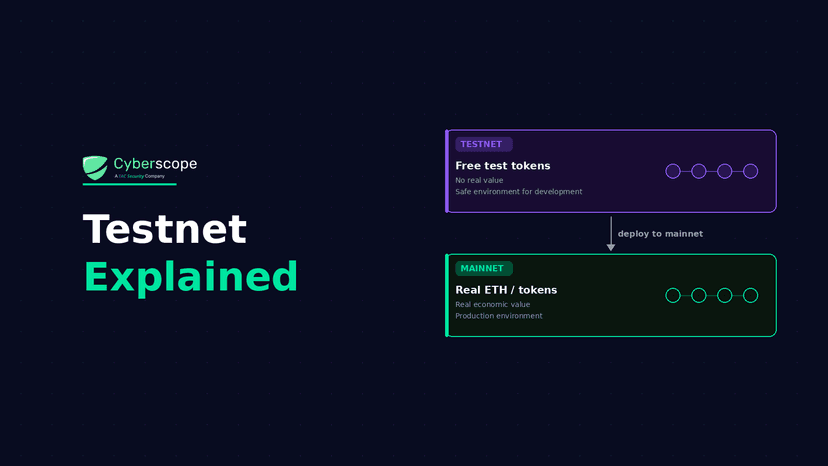
In simple terms, a testnet is a safe, simulated version of a blockchain, built so developers can experiment, break things, and fix them without putting a single dollar of real value at risk. It is where code gets validated before it ever reaches mainnet, where actual money starts moving.
Skipping this step is exactly how projects end up with service outages, broken upgrades, or vulnerabilities that attackers find before anyone on the team does. Rigorous testing exists precisely to catch these problems early, while the stakes are still zero. A smart contract audit is an essential part of getting ready for mainnet, but it works best as a final check on code that has already been thoroughly exercised on a testnet, not as a replacement for that testing.
By the end of this guide, you should have a clear picture of what a testnet actually is, how it differs from a mainnet, what testnet tokens and faucets are for, and why this entire phase matters as much for security as it does for functionality.
What Is a Testnet
A testnet is a parallel blockchain built to mimic the behavior of a specific mainnet as closely as possible, without actually being connected to it in any meaningful way. It runs independently, using its own separate chain of blocks, which means whatever happens there, successful or catastrophic, has zero effect on the real network it is modeled after.
This separation is exactly what makes testnets useful. Teams can deploy smart contracts, launch dApps, simulate new features, and stress test upgrades in an environment that behaves like the real thing without carrying any of the real risk. Before any code goes through a formal audit, it should already have been run through its paces on a testnet repeatedly, since an audit is far more effective when it is reviewing code that has already survived real world style conditions rather than catching basic functional bugs an audit was never really designed to find in the first place.
Every error, every flaw, every edge case that shows up during this phase gets fixed with no consequences attached. That is the entire point. Teams iterate until the project is genuinely ready for mainnet, not just theoretically ready.
The Role of Testnet Tokens and Faucets
Testing anything meaningful on a blockchain requires tokens, since gas fees, transfers, and staking interactions all need something to actually move. Using real assets for this would completely defeat the purpose of a risk free environment, which is exactly why testnet tokens exist.
Testnet tokens are cryptocurrencies that exist only within a specific test network. They behave identically to their mainnet counterparts, testnet ETH on Sepolia acts just like real ETH for testing purposes, but they carry zero real world monetary value. You cannot sell them on an exchange, and you cannot spend them on anything outside the testnet itself. Their entire job is to simulate the token mechanics a project actually needs to test.
A faucet is the tool that distributes these tokens, typically in small, rate limited amounts. A few things are worth knowing about how faucets work in practice:
- Limited supply and rate limits. Most faucets cap how many tokens a single address can request and how often, often something like 0.1 testnet ETH per address per day, which keeps tokens available for everyone who actually needs them for testing rather than letting a few addresses hoard the supply.
- Network specific tokens. Each testnet has its own token and its own faucet. Sepolia serves Ethereum, for example, while other networks run their own equivalents. Tokens from one testnet are meaningless on another testnet or on any mainnet.
- Genuinely essential despite having no value. Testnet tokens let developers rigorously test gas calculations, token transfers, and broader economic mechanisms under realistic conditions, well before the code is ready for the kind of scrutiny that comes with penetration testing or a formal audit.
From Devnet to Mainnet: The Blockchain Testing Journey
Most blockchain projects move through three distinct stages on their way from an idea to a live product, and each one exists for a specific reason.
Devnet: The Earliest Stage
Devnet, short for development network, is usually run locally or in a tightly controlled private environment, accessible only to the core development team. This is where the actual building happens: core feature development, initial prototyping, unit testing, and basic integration checks. Security matters here, but the priority is getting the functionality working in the first place, often through an environment that gets reset and rebuilt constantly as the team iterates.
Testnet: Closer to the Real Thing
Once the core functionality is working, a project moves to a public or semi-public testnet, one built to mimic mainnet conditions far more closely, matching real consensus mechanics and block timing. This is where broader testing happens: integration with other systems, user acceptance testing, load testing, and genuine security review. Bugs that slipped past Devnet tend to surface here, and this is often the stage where external security partners run initial assessments or where a project opens up a bug bounty program to get more eyes on the code. Multiple testnet rounds, an alpha phase followed by a beta phase, are fairly common for anything complex. Our explainer on how consensus actually works in blockchain is a useful companion here, since replicating consensus behavior accurately is one of the harder parts of building a realistic testnet in the first place.
Mainnet: The Live Network
Mainnet is the final destination, the live, production blockchain where real assets move and real economic consequences apply. This is where miners or validators, gas fees, and the network's actual consensus mechanism all operate at full stakes. Getting to this point safely typically requires a comprehensive, final smart contract audit beforehand, since this is the point where mistakes stop being free lessons and start being genuine financial losses.
It is worth noting that mainnet exists across every layer of blockchain architecture, whether that is a Layer 1 network like Ethereum or Bitcoin, or the Layer 2 and Layer 3 solutions built on top of them. Our guide to layer 1 and layer 2 blockchains covers how these layers actually relate to each other if that distinction is still fuzzy.
Testnet Faucets and Testnet Tokens, Revisited
Since faucets come up so often in testnet conversations, it is worth restating plainly what they actually provide: free, small amounts of testnet tokens distributed to a wallet address on request, letting anyone test a dApp or protocol without touching real funds. Most faucet services cap how much any single address can claim within a given period, which keeps the system fair and functional for the whole testing community rather than a handful of early requesters.
Testnet Airdrops
Stress testing a network properly requires real participation, not just a handful of internal testers clicking through the same few flows repeatedly. Because of this, plenty of testnets are incentivized, with projects rewarding active participants through airdrops of native tokens or NFTs once the mainnet actually launches. If airdrops themselves are still a bit fuzzy, our broader guide to crypto airdrops covers how these reward mechanisms typically work outside the testnet context as well.
Incentivizing testnet participation like this serves a few genuinely useful purposes:
- Attracting real testers. Finding people willing to put in the effort of thorough testing is genuinely hard. A future reward pulls in a much wider, more motivated pool of participants.
- Simulating real usage more accurately. Incentivized users tend to explore a dApp more thoroughly than purely voluntary testers, which surfaces edge cases and usability problems that a small internal team would likely miss entirely.
- Building an early community. Participants who feel genuinely invested during the testnet phase are far more likely to become real users and advocates once mainnet goes live.
- Generating pre launch attention. Testnet airdrops double as a fairly effective marketing tool, building buzz well before the official launch date.
- Surfacing Sybil resistance issues. Watching how people actually participate can reveal weaknesses in a project's defenses against fake or duplicate accounts before those weaknesses matter on mainnet. Our piece on Sybil attacks on the blockchain goes into more detail on how these attacks actually work and why testnets are a reasonable place to catch early warning signs of them.
Why Testnets Matter
A few benefits stand out clearly once you look at what testnets actually accomplish:
- A genuinely ideal testing environment, where new ideas and features get exercised using tokens that carry no real financial weight, making it far easier to spot inefficiencies and flaws honestly.
- Real risk mitigation, since errors made during development simply do not translate into real financial loss when they happen here instead of on mainnet.
- Community engagement and education, giving developers, testers, and the wider community a shared space to collaborate, report bugs, and get familiar with a protocol before it goes live.
The Security Case for Testnets
The security argument for testnets is honestly hard to overstate:
- Enhanced security. Vulnerabilities in smart contracts and protocols get identified and fixed before real funds are anywhere near them, functioning as a genuine pre-audit step rather than a substitute for one.
- Risk free experimentation. New features, upgrade mechanisms, and complex interactions can all be tested without risking financial loss or disrupting a live network.
- Cost efficiency. Free testnet tokens and infrastructure avoid the real gas costs that come with testing directly on mainnet.
- Better performance and reliability. Bottlenecks, scalability limits, and bugs tend to surface clearly under simulated real world conditions.
- Faster development cycles. Catching a problem on a testnet is dramatically cheaper and quicker than fixing the same problem after a mainnet launch.
- Genuine community validation. Real user feedback gathered before launch tends to be more useful than any amount of internal testing alone.
Closing Thoughts
A testnet is where developers and a genuine sample of future users come together to actually put a project through its paces before real money is on the line. That kind of collaborative pressure testing is a healthy, necessary part of building anything in a space that moves as fast as crypto does.
One practical note worth repeating: when you are actually transacting with real, valuable tokens, always double check that your wallet is set to the mainnet network, not a testnet. It is a small habit that prevents a genuinely frustrating and entirely avoidable mistake.
Testing thoroughly on a testnet is what gives a smart contract audit something solid to actually review, rather than code still riddled with basic functional bugs. If your project is approaching mainnet and you want that final layer of assurance done properly, reach out to us and we can walk through what a full audit engagement looks like for your specific setup.
Frequently Asked Questions
Are testnet tokens real money? No. They carry no real world value, cannot be traded on any exchange, and cannot be used for anything outside the testnet environment. Their only purpose is testing functionality without financial risk.
How long does a testnet phase usually last? It depends entirely on the project's complexity, the scope of testing required, and the feedback being gathered along the way. Most projects publish an expected timeline in their roadmap or whitepaper, though these dates tend to shift as testing reveals more work than originally planned.
Where do I get testnet or Devnet tokens? Testnet tokens come from testnet faucets, websites or tools built specifically for each network, such as a Sepolia faucet for Ethereum's Sepolia testnet. You typically submit your testnet wallet address and sometimes complete a small task in exchange. Devnet tokens, by contrast, are usually managed internally by the development team and are not distributed publicly.
What kind of wallet do I need for a testnet? The same wallet you already use for mainnet works fine. The only change needed is switching the network setting inside your wallet from something like Ethereum Mainnet to the specific testnet you want to interact with.
Can testnets be used for real transactions? No. Testnets are entirely separate blockchains from mainnet. Any transaction made there uses valueless testnet tokens and has zero impact on the real network where actual value moves.
What is the actual difference between a testnet and a mainnet? A testnet is a practice blockchain for development and testing, where tokens hold no real value. Mainnet is the live network processing genuine transactions and assets. Developers rely on testnets to catch and fix problems before anything reaches mainnet, where those same problems would carry real consequences.
This article is for educational and informational purposes only and does not constitute financial advice. Always do your own research before investing.
Recent Posts
Cryptocurrency Security Standard: What Is CCSS?
2 months ago
Blockchain and Web3 Incident Response
2 months ago