Blockchain Infrastructure Security Guide
5 minutes ago


Nov 10, 2026
Most conversations about crypto security start and end with smart contracts. That makes sense, because contract exploits tend to make the headlines. But a smart contract is only one layer of a much larger stack, and an attacker does not need to find a bug in your Solidity or Rust code if there is an easier way in somewhere else.
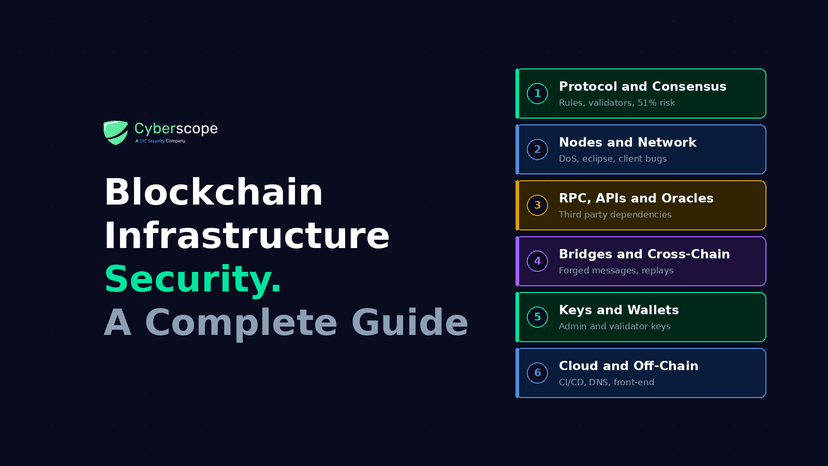
Blockchain infrastructure security is the practice of protecting every layer that a blockchain application depends on to run. That includes the base protocol and its consensus mechanism, the nodes and validators that keep the network alive, the RPC endpoints and APIs that applications use to talk to the chain, the bridges that connect networks together, the wallets and keys that control funds, and the cloud environments quietly hosting much of it all. If any one of these layers fails, the layers above it inherit the problem, no matter how clean the contract code looks on paper.
It is also worth being clear about what this guide does not cover. A smart contract audit reviews the logic of the code you deploy. Infrastructure security looks at everything that code runs on and everything it connects to. The two are complementary, and a serious project needs both. If you want a broader view of how these disciplines fit together, our definitive guide to blockchain security services is a good place to start.
Contract auditing has matured a lot over the past few years. Teams know to get a review before launch, and the common vulnerability classes are well understood. Attackers have noticed, and many have shifted their attention to the parts of the stack that receive less scrutiny.
Some of the largest losses in the industry's history had very little to do with a flaw in contract logic. The Ronin bridge incident, for example, came down to an attacker gaining control of enough validator keys to approve fraudulent withdrawals. The code did what it was told to do. The problem was who controlled the keys. Our roundup of the biggest cryptocurrency hacks of all time shows this pattern repeating across several major incidents.
There is also a structural reason infrastructure is attractive to attackers. Blockchains are public, which means anyone can study how a network behaves, probe its nodes, and watch its transactions in real time. That openness is a strength for transparency and a gift for reconnaissance.
At the bottom sits the protocol itself, including the rules that decide how nodes agree on the state of the ledger. Weaknesses here are rare but severe. A flaw in a consensus implementation, or an economic design that makes attacking the network cheap, can undermine everything built on top of it. Smaller proof of work networks have suffered 51 percent attacks, where an attacker rents or controls enough hash power to rewrite recent history and double spend. Proof of stake networks face their own versions of the problem, from validator collusion to stake concentration. If the fundamentals are new to you, our explainer on how consensus works in blockchain covers the mechanics.
Teams building or forking a base chain need this layer examined directly, which is the purpose of a dedicated layer one audit. It goes well beyond what a standard application level review would ever touch.
Nodes and validators are the machines that actually run the network, and they are ordinary computers connected to the open internet. That makes them targets for denial of service attacks, for eclipse attacks that isolate a node from honest peers and feed it a false view of the chain, and for plain old server compromise through unpatched software or exposed management ports.
Client diversity matters here too. When most of a network runs a single software implementation, one bug in that client can threaten the entire chain at once. Networks that encourage several independent clients are more resilient for exactly this reason. Sybil attacks, where one actor poses as many nodes to gain disproportionate influence, are another concern at this layer, and we explain how they work in our guide to Sybil attacks on the blockchain.
Applications rarely run their own full nodes. Most rely on third party RPC providers and APIs to read from and write to the chain, and many depend on oracles to bring off chain data, like asset prices, on chain. Each of these is a dependency, and each is a potential single point of failure.
A compromised or misconfigured RPC endpoint can return false data to a front end, hide transactions, or be used to censor users. An oracle that can be manipulated can trick a protocol into liquidating healthy positions or minting assets at the wrong price. These risks sit outside the contract itself, which is why they are so often missed in a contract only review. Injection style attacks against the services that sit between users and the chain are covered in our piece on injection attacks on the blockchain.
Bridges concentrate enormous amounts of value into a small number of contracts and validator sets, while also inheriting the security assumptions of every chain they connect. That combination has made them the most heavily targeted category of infrastructure in the industry. If you want the full picture, start with our explainer on what a crypto bridge is, then look at how the same logic applies across different ecosystems. Replay risks, where a valid transaction on one chain gets reused on another, are a recurring theme in cross-chain design, and we cover them in our guide to replay attacks in blockchain.
Every blockchain action ultimately comes down to someone, or something, holding a private key. Validator keys, admin keys, deployer keys, and treasury wallets are all high value targets, and the attacks against them are usually unglamorous: phishing, malware on a developer laptop, a poorly guarded backup, or a former team member whose access was never revoked.
Strong key management means hardware security modules or multi party computation for anything that matters, multisignature approval for privileged actions, strict separation of duties, and a documented process for rotating and revoking access. For a grounding in the basics, see our explainer on what a Web3 wallet is.
Finally, nearly every blockchain project depends on conventional infrastructure: cloud servers, CI/CD pipelines, DNS records, front-end hosting, monitoring dashboards, and internal tooling. Attackers have repeatedly gone after these because the defences are often weaker than those protecting the chain itself. A hijacked DNS record or a compromised build pipeline can push malicious code to users without touching a single smart contract.
Pulling the layers together, a handful of attack patterns account for a large share of real world incidents:
Notice how few of these require a bug in a smart contract. That is the central point of infrastructure security, and it is why a contract audit alone leaves real gaps.
No single control protects the whole stack, so assume that any individual layer can eventually fail and design the layers around it to limit the damage. A compromised RPC provider should not be able to drain funds. A leaked deployer key should not control a treasury. A single validator going offline should not halt the chain.
Code review remains essential, and a smart contract audit belongs at the centre of any launch plan. Depending on your stack, that might also mean a dedicated Ethereum smart contract audit or a Rust smart contract audit for chains such as Solana, where our guide on how secure Solana smart contracts are is a useful companion. For logic where a single flaw could be catastrophic, formal verification adds mathematical proof that critical properties hold under every input.
Penetration testing is the right tool for the parts of the stack that a code review cannot reach: APIs, node configurations, admin panels, cloud environments, and the integrations connecting your application to third party services. It simulates what a determined attacker would actually try, and it routinely finds the easy routes that nobody thought to check.
Use hardware security modules or MPC for high value keys, require multisignature approval for upgrades and treasury movements, and apply least privilege everywhere. Review who holds access on a regular schedule, and make offboarding a documented, tested process rather than an informal one. Our list of cybersecurity best practices for Web3 businesses covers many of these operational habits in more detail.
Audits and tests capture a moment in time. Infrastructure changes constantly, and attackers do not wait for your next review cycle. Real time monitoring watches for unusual transaction patterns, abnormal contract calls, and suspicious wallet activity, which can be the difference between pausing an incident in minutes and discovering it hours later from social media.
Know who can pause contracts, who holds each key, how to reach them at three in the morning, and what you will say publicly. Teams that rehearse this recover far better than those improvising under pressure.
Regulation is increasingly part of the infrastructure conversation, particularly for projects serving users in the UK and EU. Identity checks through KYC verification and alignment with frameworks such as MiCA sit alongside technical controls, and our complete guide to Web3 security compliance explains how the pieces connect.
Before launch, and again at regular intervals afterwards, you should be able to answer yes to the following:
If any of these is a no, that is where to focus first.
Blockchain security does not stop at the edge of a smart contract. The protocol, the nodes, the access layer, the bridges, the keys and the cloud environment underneath all need the same level of care, because attackers will always take the path of least resistance. Projects that treat infrastructure as a first class security concern, rather than an afterthought handled by whoever set up the servers, are the ones that avoid becoming the next case study.
The practical route is straightforward: audit the code, test the surrounding systems, protect your keys, monitor around the clock, and prepare for the day something goes wrong. If you are building on a new chain or launching a protocol and want a security partner across the whole stack, get in touch with Cyberscope to talk through what the right scope looks like for your project.
5 minutes ago

3 months ago