

Ethereum Virtual Machine Explained

CyberScope
Jul 17, 2026
What Is the Ethereum Virtual Machine (EVM)?
Ethereum gets described as a blockchain, a smart contract platform, and the backbone of most of DeFi, all of which is true, but none of it actually explains how the network runs code. That part comes down to a single piece of infrastructure sitting underneath everything: the Ethereum Virtual Machine, or EVM.
The EVM is a decentralized runtime environment that executes smart contracts, processes transactions, updates account balances, and keeps track of the state of the entire Ethereum blockchain. It is not a physical machine sitting in a data center somewhere. It is software that runs identically across thousands of independent nodes at once, which is exactly why Ethereum works the way it does. There is no central computer making decisions. Every node runs the same computation and arrives at the same result, and that shared agreement is what makes Ethereum more than just a distributed ledger. It is what turns it into the largest smart contract and dApp enabling blockchain in the industry.
Understanding a Virtual Machine First
Before the EVM makes much sense, it helps to understand what a virtual machine actually is in general computing terms.
A virtual machine is a software based emulation of a physical computer. It has its own CPU, memory, configuration, and the ability to run software, all without being an actual piece of hardware. It behaves like an independent computer even though it is really just a program running on top of a real one, known as the host machine. This is how someone running Linux can still install and run Windows only software: they spin up a virtual machine with a Windows environment inside it, install the program there, and run it as if it were a separate physical computer entirely.
A decentralized virtual machine takes that same idea and removes the single host altogether. Instead of running on one machine, it runs across a network of participating nodes that collectively provide the computing power needed to execute its operations. The EVM is exactly this kind of decentralized virtual machine, purpose built to run smart contracts across Ethereum's network. Because there is no single computer responsible for running it, and no central authority controlling it, the EVM is naturally resistant to censorship and tampering. There is no single point of failure to attack, since every node is independently running the same computation and checking the result against the network's consensus rules.
The Language of the EVM
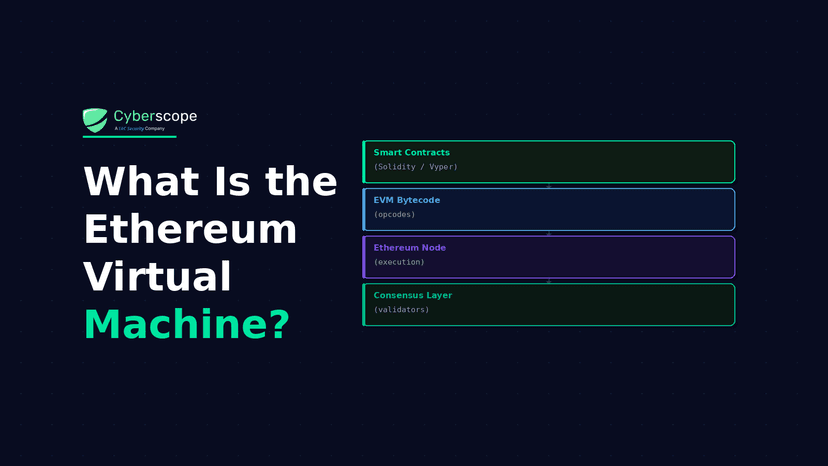
Developers do not write smart contracts in a language the EVM can read directly. The most common language for Ethereum development is Solidity, with Vyper as a smaller but notable alternative. Since the EVM has no concept of human readable code, that Solidity or Vyper code has to be translated before it can actually run on the network.
That translation is handled by a compiler, which converts human written code into bytecode, the machine readable format the EVM actually understands. The EVM itself has a fixed set of roughly 158 predefined instructions, known as opcodes, or operational codes. Every sequence of bytecode ultimately maps back to one or more of these opcodes, covering everything from basic arithmetic and memory operations to comparisons, logging, and stopping execution entirely. When a smart contract runs, the EVM is really just working through a chain of these opcodes in order, one instruction at a time.
If you are building or reviewing an ERC-20 token, it is worth understanding how that standard actually maps onto EVM operations under the hood, which we cover in more depth in what an ERC-20 token is and how to create one.
Gas: The Fuel That Powers the EVM
Every one of those opcodes has a cost, and that cost is paid in gas. Gas is simply a unit of measurement used to price each operation the EVM executes, and the total gas required for a transaction depends directly on how many opcodes that transaction actually triggers. More opcodes, more computation, higher gas fees. It is a fairly direct relationship once you understand what is happening underneath a transaction.
In practical terms, paying gas means paying for the opcodes the EVM needs to execute on your behalf. No computation runs for free, and a transaction without enough gas attached simply will not process. This is not an accident of design. The gas mechanism exists specifically to deter spam and denial of service attacks against the network. An attacker attempting to flood Ethereum with junk transactions has to pay real money for every single one of them, which makes that kind of attack expensive and, in most cases, simply not worth attempting.
For developers, this also means gas efficiency is a genuine design constraint, not just a nice to have. Poorly written contract logic can burn far more gas than necessary, and in more serious cases, unbounded loops or inefficient storage patterns can make a contract prohibitively expensive or even unusable under certain conditions. This is exactly the kind of thing a proper gas optimization audit is designed to catch before a contract goes live.
Other Key Features Worth Knowing
Turing completeness. The EVM is Turing complete, meaning it can theoretically solve any computational problem given enough resources. In practice, gas is the limiting factor. A computation that would technically be possible on the EVM can still fail simply because it costs more gas than anyone is willing or able to pay, which puts a real, practical ceiling on how complex any single on-chain computation can get.
Stack, memory, and storage. The EVM works with three distinct spaces for holding data. The stack is temporary working space, capped at 1024 items, where most operations actually happen. Memory is also temporary, but slightly more flexible, and gets wiped clean the moment a contract finishes executing. Storage is the only one of the three that is permanent, writing data directly onto the Ethereum blockchain itself, and it is also, unsurprisingly, the most expensive of the three to use in terms of gas.
Sandboxed execution. Smart contracts run inside an isolated environment, separate from the rest of the blockchain's infrastructure. This sandboxing means that whatever a contract does during execution cannot compromise the broader network, and it guarantees that the exact same input will always produce the exact same output, regardless of who is running the computation or where.
Security Implications of Building on the EVM
The properties that make the EVM powerful, determinism, permanence, and gas metered execution, are also exactly what make smart contract security such a serious concern. Once a contract is deployed and its logic is running through the EVM, a mistake in that code is not something you patch quietly overnight. Storage is permanent, execution is public, and any vulnerability sitting in the bytecode is available for anyone to find and exploit.
This is why a proper smart contract audit before deployment matters so much on EVM based chains specifically. Since Solidity compiles down to a fixed, well documented set of opcodes, auditors can trace exactly how a contract will behave at the EVM level, not just read the Solidity source and hope it does what it appears to do. Our Ethereum smart contract audit service focuses specifically on this kind of review, and for contracts handling significant value, pairing that with formal verification adds a mathematical layer of assurance on top of manual review, confirming the code behaves correctly under every possible input rather than just the ones a human auditor thought to test.
Two attack patterns come up often enough on EVM chains that they deserve specific mention. Replay attacks exploit situations where a valid transaction on one chain gets rebroadcast and accepted on another, something that becomes especially relevant around hard forks or EVM compatible sidechains sharing similar transaction formats. And fallback function vulnerabilities exploit a quirk specific to how the EVM handles calls to functions that do not exist on a contract, a pattern that has been at the center of some fairly well known exploits over the years. Beyond the initial audit, ongoing real time monitoring and periodic penetration testing help catch the kind of unusual on-chain behavior that only shows up once a contract is live and handling real transactions. If you are budgeting for any of this, our guide on what it costs to audit a smart contract is a good starting point.
EVM Compatibility and the Wider Ecosystem
Ethereum's dominance in the smart contract space has made the EVM something close to an industry standard. Rather than building an entirely separate execution environment from scratch, a long list of other networks have chosen to make themselves EVM compatible instead, including BNB Chain, Polygon, Avalanche's C-Chain, Optimism, and Arbitrum, among others. If you want a broader sense of how these chains fit together architecturally, our explainer on layer 1 and layer 2 blockchains is a useful next read.
EVM compatibility means these networks can run the exact same smart contracts Ethereum runs, which makes life considerably easier for developers, who can deploy a single codebase across multiple chains with little to no modification. It also explains why wallet addresses across all of these networks follow the same format, starting with 0x followed by 40 alphanumeric characters. A single wallet works across every EVM compatible chain, and switching between them is often just a matter of changing the connected network rather than creating a new address. Moving assets between these chains typically still requires a crypto bridge, which comes with its own set of security considerations worth understanding separately.
Not every major blockchain follows this model, of course. Solana, for example, uses a completely different execution environment built primarily in Rust rather than the EVM's Solidity based approach, which is why Solana smart contract security looks meaningfully different from EVM auditing, and why our Rust smart contract audit service exists as a separate offering rather than an extension of our EVM work.
Closing Thoughts
Ethereum has held its position as the dominant smart contract platform for years now, and the EVM is the primary reason why. It is the layer that turns Solidity code into deterministic, verifiable, network wide computation, and its influence now extends well beyond Ethereum itself through the growing list of EVM compatible chains built around the same execution model.
Understanding how the EVM actually works, gas, opcodes, the stack and storage model, and the security implications that come with all of it, is genuinely useful whether you are writing smart contracts yourself or simply trying to evaluate whether a project you are interested in has been built responsibly. The mechanics are not as intimidating as they first sound, and once they click, a lot of what happens on-chain starts making a great deal more sense.
This article is for educational and informational purposes only and does not constitute financial advice. Always do your own research before investing.
Recent Posts
Cryptocurrency Security Standard: What Is CCSS?
2 months ago

Blockchain and Web3 Incident Response
2 months ago