

Blockchain Explorers Explained: What They Are and How to Use Them

CyberScope
Jul 17, 2026
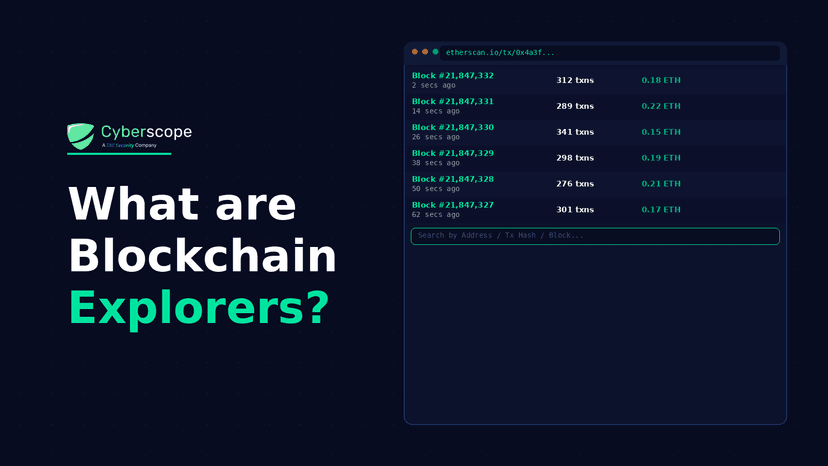
What Are Blockchain Explorers and How to Use Them
If you have ever pasted a transaction hash into a search bar just to see whether your crypto actually arrived, you have already used a blockchain explorer, whether you called it that or not. These tools are one of the quiet backbones of the entire crypto ecosystem, and yet most people only think about them the moment something goes wrong with a transfer. That is a shame, because a good explorer can tell you far more about a network, a project, or a wallet than most people realize.
A blockchain explorer, sometimes called a block explorer, is a web based application that lets anyone view, search, and analyze the data sitting on a blockchain. Think of it as a search engine built specifically for on-chain activity. Instead of indexing web pages, it indexes blocks, transactions, wallet addresses, and smart contracts, and it presents all of that information in a format a regular person can actually read, rather than raw hexadecimal data that only makes sense to a node operator.
Most explorers are built for one specific network. Etherscan, for example, exists purely to track activity on Ethereum. Other chains have their own dedicated versions, each tuned to the particular quirks of that blockchain's data structure. In every case though, the underlying idea is the same: give people equitable, transparent access to information that would otherwise sit buried inside distributed nodes.
Core Metrics and Features of Blockchain Explorers
At a basic level, a block explorer shows you the latest transactions moving through a network, the wallets involved in them, the most recent block that was mined or validated, and the network's current transactions per second. Drill down further into a specific wallet and you will typically find its full transaction history, current balance, and the fees it has paid over time.
Beyond the basics, most explorers surface a fairly wide range of data points, including:
- Market data, such as current price, market capitalization, total supply, and circulating supply
- Blockchain level data, including average block size, average block time, daily active addresses, and unique addresses
- Network data, covering pending transactions sitting in the mempool, current hash rates, and general node statistics
- Activity happening on decentralized exchanges
- Block rewards and block difficulty
- Current gas prices or network fees
- Details on the latest block produced
A lot of this information gets presented visually, through charts, tables, and graphs, which makes it far easier to spot trends than scrolling through raw transaction logs ever would.
One feature deserves special mention: the search bar. It is deceptively simple, but it is really the entry point to everything else an explorer offers. Paste in a wallet address, a transaction hash, a block number, or even a domain name, and the explorer pulls up everything associated with it. Given how central wallet addresses are to this whole process, it is worth understanding what is actually sitting behind one of these addresses, which we cover in more detail in what a Web3 wallet actually is.
Why Blockchain Explorers Actually Matter
It is easy to treat an explorer as just a lookup tool, but its real value shows up once you start using it regularly.
Gaining insight through data. Anyone tracking a blockchain ecosystem, whether as a researcher, an investor, or simply a curious participant, can use an explorer to study transaction volumes, active addresses, network fees, and other on-chain signals that tend to say more about real usage than a token's price chart ever will.
Exploring specific addresses. You can keep an eye on a project's treasury wallet, or dig into a token's contract address to understand how holdings are distributed across the community. That kind of visibility matters more than people give it credit for, especially before committing funds to a new project. If you want a more structured way to check whether a given contract looks safe before interacting with it, our guide on how to check if a smart contract is safe walks through the process, and pairs naturally with the kind of research an explorer supports.
Watching whale activity. Large holders tend to move markets, intentionally or not, and explorers make it possible to track the on-chain behavior of significant wallets or otherwise influential addresses without needing any special access.
Verifying transactions. This is probably the most common everyday use. An explorer lets you confirm whether a payment has actually been processed and included in a block, which functions as a receipt of sorts when crypto is used for a real payment. If a transfer ever goes wrong or funds end up somewhere unexpected, our piece on what to do if you have been the victim of a crypto scam is worth reading alongside whatever the explorer shows you.
Monitoring blocks. Beyond individual transactions, explorers surface details about entire blocks, including block height, the miner or validator responsible, the timestamp, and every transaction bundled inside it.
How to Actually Use a Blockchain Explorer
Using one is more straightforward than it might sound at first.
Start by finding the explorer built for the specific network you care about, since each chain generally has its own. From there, the process breaks down into a couple of simple steps.
First, copy the block number, block hash, transaction hash, or wallet address you want to look up, paste it into the main search bar, and hit enter. The explorer will figure out what type of data you have pasted in and pull up the matching record automatically.
Second, review what comes back. For a block, expect to see its size, the miner or validator address, a full list of transactions included in it, and a timestamp. For a transaction, you will typically find the transaction hash, the timestamp, the sending and receiving addresses, the amount transferred, and the fee paid. For a wallet address, the explorer will show the current balance, a list of recent transactions, and any tokens held by that address.
Charts and Analytics
Most explorers also offer a dedicated analytics section, usually tucked under a heading like Resources, Data, Analytics, Charts, or Statistics on the site's main navigation. The exact wording varies from one explorer to another, but it is almost always one of those.
Once you find it, you can browse a wide range of visualized metrics, daily transaction counts, unique active addresses, daily gas consumption, and plenty more depending on the chain. These charts are genuinely useful for spotting longer term trends that a single transaction lookup would never reveal, whether that is a network's growth curve or a sudden spike in activity worth investigating further.
The Security Side of Blockchain Explorers
Here is where explorers become more than a convenience tool and start doubling as a genuine security resource. Because every transaction on a public blockchain is visible, an explorer effectively turns raw ledger data into a monitoring tool for anyone willing to use it that way.
Security researchers use explorers constantly to trace suspicious transactions, follow stolen funds across multiple wallets, and identify patterns associated with known attack types. Our breakdown of replay attacks in blockchain and address poisoning scams both describe attack patterns that become far easier to spot once you know how to read an explorer properly. If you want to go beyond manual checks, our own free smart contract audit tools build on this same kind of on-chain visibility to flag risk automatically.
For projects and businesses, this same transparency ties directly into ongoing security practice. A one time smart contract audit establishes a baseline, but explorers, combined with proper real time monitoring, are what actually catch unusual activity after launch, when a contract is live and real money is moving through it. Exchanges and platforms that need to trace the origin of funds for compliance reasons also lean on explorer data heavily, which is part of why know your transaction monitoring and standard KYC checks tend to go hand in hand with on-chain analysis rather than replacing it. If you are evaluating whether a project's published audit actually holds up, our guide on what to look for in a security audit report is a good companion piece, since cross referencing an audit's claims against actual on-chain activity is one of the more reliable ways to verify them.
Closing Thoughts
Blockchain explorers do something genuinely valuable that gets taken for granted far too often: they make an entire distributed ledger transparent and searchable by anyone, without needing permission or technical expertise. Whether you are confirming a payment went through, researching a new project before investing, tracking a whale wallet, or investigating suspicious activity, the explorer built for that chain is usually the fastest and most reliable place to start.
Getting comfortable with reading an explorer is one of the more underrated skills anyone spending real time in crypto can pick up. It turns a lot of what feels like guesswork, whether a transaction went through, whether a contract looks legitimate, whether a project's holder distribution looks healthy, into something you can actually verify yourself in a couple of minutes.
This article is for educational and informational purposes only and does not constitute financial advice. Always do your own research before investing.
Recent Posts
Cryptocurrency Security Standard: What Is CCSS?
2 months ago
Blockchain and Web3 Incident Response
2 months ago