

Institutional Crypto Custody Providers Explained

CyberScope
Jul 17, 2026
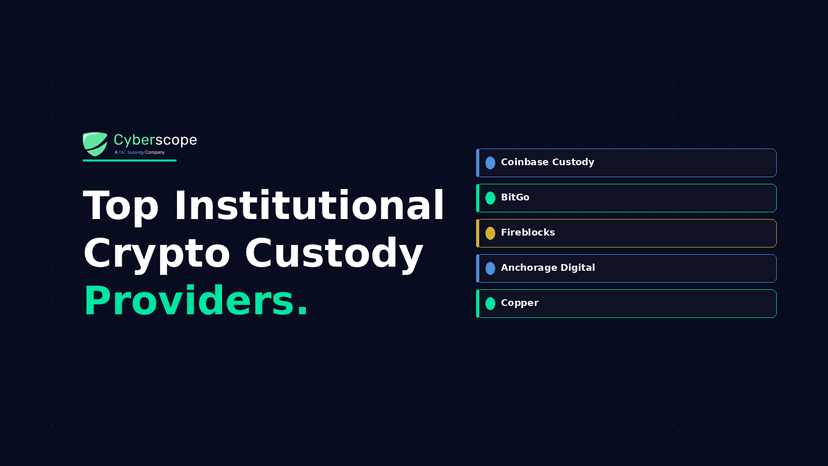
Top Institutional Crypto Custody Providers (2026)
Crypto has fully entered institutional territory. Spot ETFs, tokenized real world assets, corporate digital asset treasuries, fintechs building on stablecoin rails, and a genuine wave of cross border payment activity have all pushed traditional finance further into this space than most people expected even a couple of years ago. As that shift continues, secure and compliant custody has become one of the least glamorous but most critical pieces of infrastructure underneath all of it.
For an institution, custody is not just a place to park assets. The right provider safeguards holdings, but it also determines how well an organization can stay compliant, settle transactions quickly, and avoid the operational friction that comes with managing digital assets at scale. Custody providers exist precisely to solve this, offering the infrastructure that fintechs, exchanges, asset managers, and corporates rely on to hold and manage assets professionally rather than improvising their own solution.
Below is a rundown of the institutional custody providers worth knowing in 2026, along with the factors that actually matter when choosing between them.
1. Coinbase Custody
Coinbase's institutional custody arm serves banks, fintechs, exchanges, asset managers, and corporate clients, built around regulatory trust structures and enterprise grade security, with integrated staking and governance tools layered on top. Regular SOC 1 and SOC 2 audits back the platform.
- Coverage: Primarily the US, with global eligibility depending on jurisdiction
- Regulatory standing: Operates as a fiduciary under New York state banking law and holds Qualified Custodian status
- Insurance: Institutional grade coverage on assets in storage
- Fees: Customized per client, typically an annualized custodial fee
- Supported assets: Over 470
2. BitGo
BitGo has been building toward this exact moment since 2013, positioning itself as the bridge between traditional finance expectations and crypto native security. Its infrastructure relies on fully offline cold storage alongside multi-signature or MPC based key management, backed by a substantial insurance program.
- Regulatory standing: Operates regulated entities across the US, Europe, Singapore, and Switzerland
- Coverage: North America, Europe, the Middle East, North Africa, and APAC
- Insurance: Up to 250 million dollars in coverage
- Fees: Based on assets under custody, negotiated per institutional client
- Supported assets: Over 1,550
3. Anchorage Digital
Anchorage operates as a federally chartered crypto bank in the US, offering custody, settlement, staking, and fiat services under one roof. Its infrastructure is built around segregated custody, bank grade internal controls, and a genuine emphasis on auditability.
- Regulatory standing: Holds a US federal bank charter from the Office of the Comptroller of the Currency, making it a qualified custodian under US banking law
- Coverage: Primarily US based
- Insurance: Digital assets are not covered by FDIC or SIPC insurance, so institutions should confirm specific policy details directly with Anchorage
- Fees: Depends on assets under custody and the specific services used
- Supported assets: A broad and expanding range, detailed on Anchorage's own platform
4. Fidelity Digital Assets
Fidelity brought its traditional finance heritage directly into crypto custody, combining cold vault storage and multi-site key management with a trust company charter. Its client base leans heavily toward hedge funds, corporations, family offices, and asset managers already familiar with Fidelity's broader ecosystem.
- Regulatory standing: A New York State chartered trust company, also registered with the UK's Financial Conduct Authority under its cryptoasset regulations
- Coverage: North America, Europe, and select other jurisdictions
- Insurance: Not publicly stated
- Fees: Tailored to asset volume and services requested
- Supported assets: Bitcoin, Ether, Litecoin, and Solana
5. Fireblocks
Fireblocks takes a slightly different approach, built around MPC based custody paired with a dedicated transfer network rather than custody alone. The platform allows assets to move safely across wallets, exchanges, counterparties, and liquidity venues without ever exposing a private key directly. On top of that, Fireblocks supports real time stablecoin settlement, embedded wallets, and programmable treasury tools through a fairly extensive API.
- Coverage: Global
- Regulatory standing: Chartered as a limited purpose trust company by the New York State Department of Financial Services
- Insurance: Provided through partnerships with established insurance firms
- Fees: Enterprise tier pricing, often based on API usage and bespoke integration needs
- Supported assets: Thousands of assets across more than 120 blockchains
6. Gemini Custody
Gemini's institutional offering centers on cold, highly secure storage under a regulated trust structure, with assets held offline in air gapped facilities and protected by multi-party and multi-signature governance. Clients get access through a self-service portal and API integration rather than needing to go through account managers for every action.
- Regulatory standing: Operates as a qualified custodian under New York Banking Law through Gemini Trust Company
- Coverage: Primarily the US, with select global jurisdictions
- Insurance: Up to 125 million dollars for certain categories of loss
- Fees: A custody fee of 0.4 percent or 30 dollars per month per asset, whichever is greater
- Supported assets: Over 100
7. BNY Digital Asset Custody
One of the oldest and largest global banks now offers institutional custody, fund services, and tokenization infrastructure through its dedicated Digital Assets Platform, aiming to connect traditional finance directly with the emerging blockchain ecosystem. Given the scale of tokenization efforts underway across finance right now, this kind of infrastructure is likely to matter more over time, not less. Our overview of real world assets in crypto covers why tokenization has become such a significant theme for institutions specifically.
- Regulatory standing: Full licensing disclosures are available directly through BNY
- Coverage: The US, along with select countries globally and across the EU
- Fees: Bespoke, based on client needs
8. Sygnum Bank Digital Asset Custody
Sygnum operates as a fully regulated Swiss digital asset bank, running a multi-custody platform that blends bank level regulatory oversight with crypto native infrastructure. Assets are held off balance sheet and kept separate from Sygnum's own holdings, which meaningfully reduces intermediary risk even in a worst case scenario like insolvency.
- Regulatory standing: Holds a universal banking license from FINMA
- Coverage: Rooted in Switzerland, with a regulatory footprint extending across Europe and APAC
- Insurance: Up to CHF 100,000 on fiat deposits, plus limited coverage against losses such as internal fraud
- Fees: Charged in basis points annually on assets under custody, varying by volume and client profile
- Supported assets: Bitcoin, Ether, XRP, and others listed on Sygnum's platform
Factors to Consider When Choosing a Digital Asset Custodian
Picking a custodian is one of the more consequential decisions an institution will make when entering this space, and it deserves more scrutiny than comparing headline fee percentages.
Regulatory status and jurisdictional alignment. Your custodian needs to satisfy the expectations of your LPs, regulators, and internal risk committees simultaneously. Look for recognized charters and licenses, along with genuine regional expertise in the markets you actually operate in.
Security architecture. This is the real core of custody, and it deserves the closest scrutiny. Look at the full technical stack: MPC, hardware security modules, cold and deep cold storage, and whether the provider undergoes independent verification through SOC 1 and SOC 2 reports, penetration testing, and transparent proof of reserves or on-chain attestations. Understanding what to actually look for in a security audit report applies just as much here as it does when evaluating a smart contract audit. Confirm as well that your assets are never rehypothecated, meaning they should never be lent out or commingled with anyone else's holdings.
Insurance coverage and asset protection. Institutional custodians typically carry crime or specie insurance, but the limits and actual scope of coverage vary considerably between providers. Check the stated insurance limits, what specific events the policy actually covers, whether fiat deposits are protected, and whether digital assets are held off balance sheet in a way that keeps them safe even if the custodian itself becomes insolvent.
Asset coverage and staking support. A custodian needs to support what your strategy actually requires, not just Bitcoin and Ether. If restaking or validator level staking is part of your treasury strategy, confirm the custodian genuinely supports it, along with any stablecoins or tokenized assets you expect to hold going forward.
Liquidity, settlement, and trading connectivity. The strongest custodians do more than hold assets safely. They actively reduce operational drag through integrated OTC desks, prime brokerage connectivity, instant settlement networks, and reliable local on and off ramps in your priority markets.
Integrations, APIs, and operational fit. Your custodian should slot into your existing infrastructure without forcing a rebuild. Real time APIs, ERP and accounting integrations, clear reporting dashboards, and dependable local payment rails all matter more in daily practice than they tend to get credit for during the sales process.
Transparent fees and cost structure. Custody pricing varies enormously across providers, from base custody fees to setup costs, withdrawal fees, and minimum asset thresholds. Treat unclear network fee handling or opaque billing as a genuine red flag rather than a minor inconvenience.
Security for Custody-Integrated Systems
Choosing the right custodian only solves half the problem. The other half is making sure everything that connects to that custodian, your smart contract logic, treasury automation, bridges, and internal workflows, is actually secure in its own right.
Whether you are a fintech building crypto payment rails, a Web3 project managing user funds, or an enterprise wiring digital asset custody directly into your existing product stack, independent security validation is no longer a nice to have. It is what regulators, partners, and institutional clients now expect as standard practice, and our complete guide to web3 security compliance covers how these pieces typically fit together across a real institutional setup.
This is where Cyberscope's own work fits directly alongside custody. Our services cover:
- Smart contract audits for custody related logic, wallets, bridges, tokenization flows, and treasury modules, backed where needed by formal verification for the highest risk components
- Real time monitoring and on-chain risk intelligence, running continuously rather than as a one time check
- Penetration testing for infrastructure that interacts directly with custodians, APIs, and settlement systems
- KYC and MiCA compliance support, tailored to institutions operating across multiple regulatory regions. Our breakdown of KYC versus AML in crypto compliance is a useful starting point if your team is still mapping out where each requirement applies
Your custodian is responsible for protecting your assets. Making sure everything around that custodian is just as secure is a separate job, and it is the one Cyberscope focuses on.
This article does not represent financial, legal, insurance, or tax advice. Everything written here is strictly for educational and informational purposes.
Recent Posts
Cryptocurrency Security Standard: What Is CCSS?
2 months ago
Blockchain and Web3 Incident Response
2 months ago