

BRC-20 Explained

CyberScope
Jul 17, 2026
BRC-20 Explained: How Tokens Work on the Bitcoin Network
Bitcoin was built with a fairly narrow purpose in mind. A peer to peer medium of exchange, an alternative to fiat money, with security and decentralization as the priorities rather than flexibility. For most of its history, that is exactly what it stayed.
Since 2009 though, the wider blockchain space around Bitcoin has moved a long way past simple value transfer. Other networks built entire token economies on top of standards like ERC-20 on Ethereum, supporting everything from stablecoins to governance tokens to full smart contract platforms. Understanding the economic design behind these tokens matters just as much as understanding the code behind them, which is exactly what a proper tokenomics review is meant to cover.
Bitcoin, by comparison, sat mostly outside that trend, at least until part of its community decided it did not have to. That effort eventually produced BRC-20, an experimental standard that lets people create fungible tokens directly on the Bitcoin network. This guide walks through what BRC-20 actually is, how the standard came about, how these tokens work in practice, and how they stack up against a more familiar standard like ERC-20.
What Is the BRC-20 Token Standard
A token standard is really just a rulebook. It defines how tokens get created, transferred, and managed on a given blockchain, giving developers and wallets a shared format to build around rather than everyone inventing their own approach from scratch.
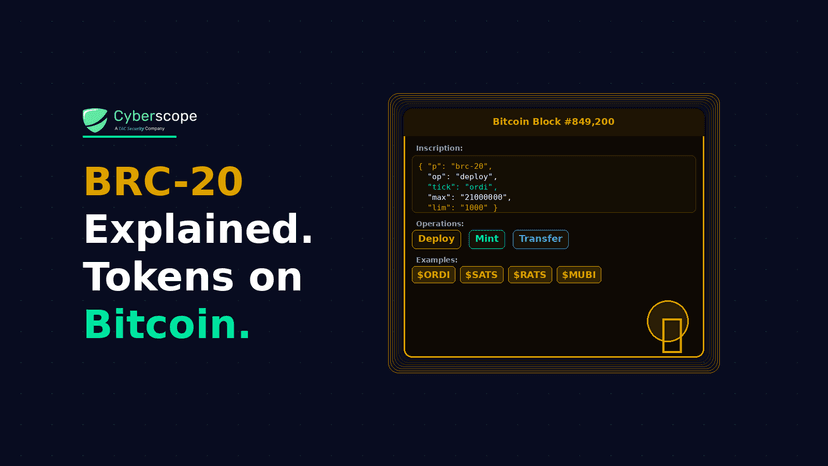
BRC-20, short for Bitcoin Request for Comment, is an experimental standard that allows fungible tokens to be minted and transferred on the Bitcoin blockchain using something called ordinal inscriptions. An anonymous developer going by the name Domo introduced it in March 2023.
At its core, BRC-20 is a novel, still very experimental way of creating alternative assets directly on top of Bitcoin, without touching Bitcoin's own base layer rules.
How BRC-20 Tokens Actually Work
Here is where BRC-20 diverges sharply from something like ERC-20. Ethereum's standard relies entirely on smart contracts. A contract deployed on-chain manages balances, enforces transfer rules, and tracks supply, all directly on the network itself.
BRC-20 has no equivalent on-chain contract. Instead, these tokens exist as immutable JSON data inscribed directly onto individual satoshis, the smallest possible unit of Bitcoin, through a system called the Ordinals protocol. Rather than living inside a contract, a BRC-20 token is really more like a satoshi that has been tagged with specific data describing a token's properties.
The rules for deploying, minting, and transferring these tokens are not enforced by the Bitcoin network itself. They are interpreted after the fact by off-chain indexers, software that reads through inscription data and determines what is valid and what is not. This is a genuinely different security model from a smart contract token, and it comes with tradeoffs. BRC-20 tokens inherit Bitcoin's base layer security for the underlying transactions, but they lack the kind of on-chain programmability that makes something like ERC-20 auditable through a smart contract audit in the traditional sense, since there is no contract logic to actually audit in the first place.
The Road to BRC-20
BRC-20 did not appear out of nowhere. It is the product of a few years of incremental upgrades to Bitcoin's own infrastructure.
It starts with Segregated Witness, or SegWit, in 2017, a genuinely divisive upgrade at the time that restructured how transaction data was organized and effectively expanded Bitcoin's usable block space, improving scalability along the way.
Taproot followed in 2021, improving privacy and introducing a new scripting language called Tapscript. This opened the door to more complex transaction types and expanded what Bitcoin scripts could actually do, even if the resulting model looks nothing like Ethereum's approach to smart contracts. If you want a clearer picture of how base layer upgrades like this compare to the layered scaling approaches used elsewhere, our explainer on layer 1 and layer 2 blockchains covers that broader landscape.
Then, in 2023, came Bitcoin Ordinals, a protocol that let people inscribe arbitrary data, images, text, video, directly onto individual satoshis, effectively creating NFTs natively on Bitcoin for the first time. BRC-20 followed almost immediately after, applying that same inscription mechanism to fungible tokens instead of one-of-one collectibles.
A few terms are worth defining clearly before going further:
- Satoshis, or sats, are the smallest unit of Bitcoin. One hundred million satoshis make up a single BTC, and each one is numbered sequentially based on when it entered circulation.
- Ordinals is the numbering system that gives individual satoshis a unique identity, making it possible to attach specific data to one particular sat rather than to Bitcoin generically.
- Inscriptions are the actual data attached to a satoshi through the Ordinals protocol, whether that is an image, a piece of text, or, in BRC-20's case, structured JSON data.
How BRC-20 Tokens Are Created
The process has three distinct phases, and understanding them helps explain both the appeal and the fragility of the standard.
Deploying. A creator writes a JSON file specifying the token's parameters, its ticker, maximum supply, and the limit allowed per individual mint transaction. That JSON gets inscribed onto a satoshi, and once confirmed on the Bitcoin blockchain, this acts as the token's official deployment, its blueprint.
Minting. Once a token has been deployed, anyone can create their own mint inscription, again in JSON format, specifying the ticker and the amount they want to claim, up to the deployment's stated limit. Off-chain indexers watch the blockchain for these mint inscriptions and track cumulative supply against the deployed maximum. Once that maximum has been fully claimed, minting simply stops, purely as a matter of the indexers no longer recognizing further mints as valid.
Trading. Because there is no smart contract managing balances, trading happens through specialized marketplaces built specifically for Ordinals and BRC-20 tokens. A seller creates a transfer inscription for the amount they want to sell and lists it on a supporting platform. A buyer then purchases that inscribed satoshi through the marketplace, and ownership effectively transfers along with the satoshi itself.
In practice, most BRC-20 activity so far has centered on speculation and trading, not unlike meme coins on other chains. The standard technically allows for tokens representing other kinds of assets or utility, but that is far less common today, largely because there is no smart contract layer to build more complex logic on top of.
BRC-20 vs ERC-20: How the Two Standards Actually Compare
The name BRC-20 is a deliberate nod to ERC-20, but the two standards work in fundamentally different ways.
Feature | BRC-20 | ERC-20 |
|---|---|---|
Underlying network | Bitcoin | Ethereum and other EVM compatible chains |
Creation method | JSON data inscribed onto satoshis via Ordinals | Smart contracts written in Solidity |
Enforcement | Off-chain indexers interpret inscription data | On-chain contract logic enforces rules directly |
Programmability | Limited, no native smart contract support | Extensive, supports complex on-chain applications |
Fungibility | Semi-fungible in practice, tied to individual satoshis | Fully fungible by design |
If you want a deeper look at how ERC-20 actually works under the hood, our guide on what an ERC-20 token is and how to create one is a good companion piece to this comparison.
This gap in programmability is not a minor technical footnote. It shapes almost everything about what each standard can realistically be used for, and it introduces a distinct set of challenges specific to BRC-20:
- Scalability and fees. A surge in inscription activity can meaningfully increase congestion and fees on the Bitcoin network, working against Bitcoin's original purpose as a simple peer to peer payment system.
- No native smart contract logic. Building anything resembling a lending protocol or automated market maker directly with BRC-20 tokens is genuinely difficult without leaning on external, off-chain infrastructure.
- Indexer reliance. The entire state of the BRC-20 ecosystem, who owns what, what has been minted, depends on independent indexers agreeing on how to interpret inscription data. Disagreement between indexers is a real point of fragility.
- Experimental maturity. The standard is still young, and newer approaches are already emerging to address its limitations.
Security Considerations Worth Taking Seriously
BRC-20 tokens inherit Bitcoin's base layer security for transaction finality, which is genuinely strong. But that security only covers the settlement layer. It says nothing about the off-chain indexers and marketplaces interpreting the inscription data, and that is exactly where most of the practical risk sits.
Because there is no on-chain contract enforcing rules, the usual due diligence steps that apply to ERC-20 style tokens, checking whether a smart contract is safe or reviewing a formal audit, do not map directly onto BRC-20. Instead, the risk shifts toward the indexers and marketplaces themselves, and toward the speculative nature of a market that leans heavily on meme coin dynamics. Given how much of the current BRC-20 landscape mirrors the incentive structures behind other speculative token launches, it is worth being familiar with how rug pulls work and how to avoid getting caught in one before putting real money into any newly deployed token, BRC-20 or otherwise.
For platforms and marketplaces built around Ordinals and BRC-20 trading, the security priorities look a little different than a typical DeFi protocol. Real time monitoring of indexer behavior and inscription activity helps catch discrepancies or manipulation attempts early, and regular penetration testing of the marketplace infrastructure itself matters just as much as it would for any other exchange handling significant trading volume. Platforms tracking the movement of funds through these marketplaces also increasingly lean on the same principles covered in our guide to know your transaction monitoring, even though the underlying asset type looks nothing like a typical ERC-20 transfer.
The Future of BRC-20: Opportunities and Challenges
BRC-20 clearly reignited interest in tokenization on Bitcoin, proving there was real demand for this kind of experimentation even on a network that was never designed with it in mind. Where things go from here is less certain, but a few threads seem worth watching.
On the opportunity side, building assets directly on Bitcoin means inheriting the security of the most established blockchain in existence, which carries genuine appeal regardless of the standard's technical limitations. Early projects like ORDI, the first BRC-20 token to gain real traction, have shown there is a real market here, and the limitations of BRC-20 itself may end up accelerating interest in Bitcoin layer 2 solutions designed to bring more programmability to the network, the same way crypto bridges have extended interoperability between otherwise isolated chains.
On the challenge side, network congestion, the total absence of native smart contract logic, and a genuinely clunky user experience compared to established standards like ERC-20 all remain real friction points. Newer approaches, including the Runes protocol, are already emerging specifically to address some of these gaps, which could either complement BRC-20 or eventually replace it as the more practical standard for Bitcoin native tokens.
Closing Thoughts
BRC-20 represents a genuinely interesting shift for a network that spent over a decade resisting exactly this kind of experimentation. It has attracted real capital and real attention, led largely by tokens like ORDI, but it remains, by design and by its own creator's framing, an experimental standard rather than a finished one.
That distinction matters. As wallet and exchange support for BRC-20 continues to expand, the sensible approach is treating it the way you would treat any early stage, rapidly evolving standard: with genuine interest, but without skipping the due diligence that any new token category deserves.
Frequently Asked Questions
What are the best BRC-20 tokens to invest in? There is no reliable answer to this, and anyone claiming otherwise should be treated with some skepticism. The standard is experimental and the market around it is genuinely volatile. ORDI tends to get the most attention simply by virtue of being first, but plenty of other BRC-20 tokens exist, many with meme coin style dynamics. Any investment decision should rest on real research into a project's utility, community, and tokenomics, alongside your own risk tolerance.
Are BRC-20 tokens secure? They inherit Bitcoin's base layer security for transaction finality, which is genuinely strong. But their actual functionality depends on off-chain indexers and marketplaces correctly interpreting inscription data, and that layer does not carry the same guarantees. There is also no on-chain contract logic behind BRC-20, unlike ERC-20, which changes what security even means in this context.
Can BRC-20 tokens be used for smart contracts? Not directly. The standard itself has no smart contract functionality built in. Building anything resembling a DeFi application purely with BRC-20 tokens would require significant off-chain infrastructure or integration with a Bitcoin layer 2 solution that brings programmability the base standard does not offer.
How can I trade BRC-20 tokens? Through specialized marketplaces built to support Bitcoin Ordinals and BRC-20, alongside a compatible wallet that can handle Ordinals inscriptions. Platform availability shifts over time, so it is worth checking that whatever marketplace and wallet you choose currently and explicitly supports BRC-20.
How do I store BRC-20 tokens? In a Bitcoin wallet built to support Ordinals inscriptions. Since the token data lives on tagged satoshis rather than in a separate ledger, storing a BRC-20 token really means securely holding those specific satoshis. Make sure any wallet you use explicitly supports viewing and transferring Ordinals safely before relying on it.
This article is for educational and informational purposes only and does not constitute financial advice. Always do your own research before investing.
Recent Posts
Cryptocurrency Security Standard: What Is CCSS?
2 months ago
Blockchain and Web3 Incident Response
2 months ago