
Security for Vibe-Coded Web3 Projects

CyberScope
Aug 07, 2026
What Vibe Coding Actually Means
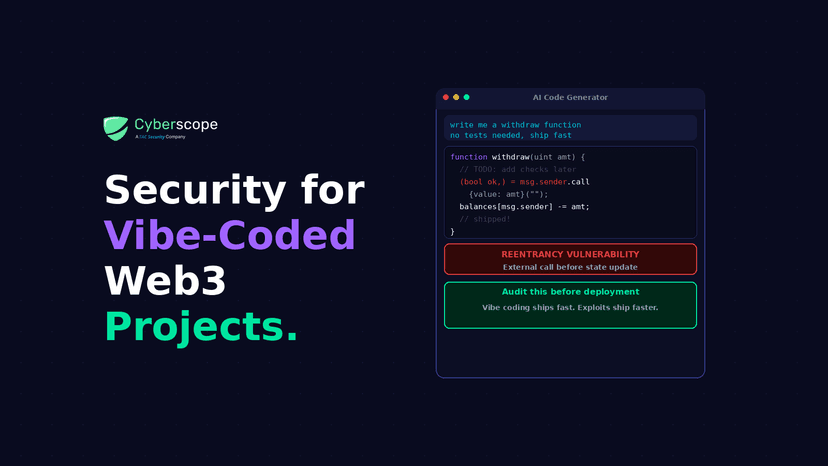
Vibe coding is the practice of building software largely through AI prompts, describing what you want in plain language, letting a model generate the code, and iterating based on whether the output feels right rather than reading every line with real understanding. It has genuinely changed how fast people can build. A founder with no engineering background can now spin up a working prototype in an afternoon, something that would have taken a hired developer weeks just a couple of years ago.
That speed is real, and it is not going away. But Web3 is a genuinely unusual environment to apply this approach to, and the reasons why deserve real attention before anyone deploys a vibe-coded contract with actual funds attached to it.
Why Web3 Makes Vibe Coding Riskier Than Other Software
Code Is Public and Permanent
A vibe-coded web app with a bug can be patched quietly overnight. A vibe-coded smart contract, once deployed, is sitting on a public ledger for anyone to read, and in most cases it cannot be changed at all. Whatever logic went in is the logic that exists, permanently, unless the team specifically built in upgradeability from the start, which introduces its own set of risks.
There Is No Patch Tuesday
Traditional software has a release cycle that assumes bugs will be found after shipping and fixed in the next update. Smart contracts do not get that luxury by default. If a vulnerability is discovered after launch, the standard playbook is closer to an emergency, pausing functions if a pause mechanism exists, coordinating a response under real time pressure, and hoping the exploit is caught before it does serious damage rather than after.
Real Money Is on the Line From Day One
A vibe-coded social app might embarrass its founder if something breaks. A vibe-coded DeFi protocol or token contract can lose real user funds the moment it goes live, sometimes within minutes if an attacker is scanning new deployments for exactly this kind of weakness. The stakes simply are not comparable to most other categories of software.
Common Failure Patterns in AI-Generated Smart Contracts
Hallucinated Logic That Looks Right
AI models are genuinely good at producing code that looks correct, follows familiar patterns, and even compiles cleanly, while still containing subtle logical errors. A model might implement an access control check that looks reasonable but actually checks the wrong condition, or generate a transfer function that handles the happy path correctly while mishandling an edge case nobody thought to test. This is arguably the most dangerous category of vibe coding risk, because the code does not look wrong to someone without the background to catch it.
Copy-Pasted Patterns Without Context
Models trained on large amounts of code tend to reproduce common patterns, which is genuinely useful when those patterns actually fit your specific contract. It becomes a problem when a pattern gets pulled in wholesale without adapting it to the actual context it is being used in, carrying over assumptions that made sense in the original source but do not hold in the new implementation. Our overview of common smart contract vulnerabilities covers several of the exact patterns that show up when this goes wrong.
Missing Access Controls
A function that should be restricted to an owner or admin address is left open to anyone, simply because the prompt did not explicitly ask for that restriction and the model did not infer it was necessary. This is one of the more common and most dangerous gaps in AI-assisted contracts, since a missing access check can hand an attacker direct control over minting, withdrawals, or contract configuration.
Weak or Absent Input Validation
Generated code sometimes assumes inputs will always be well formed and reasonable, skipping the kind of defensive checks an experienced developer would add by habit. Without proper validation, a contract can end up trusting user supplied values it should be treating with real suspicion.
Outdated or Insecure Dependencies
AI models are trained on a snapshot of existing code, which means they can suggest libraries, patterns, or versions that were reasonable at some point but have since been deprecated or found to carry known vulnerabilities. Without someone actively checking, an outdated dependency can slip straight into a live contract.
Why "It Compiles" Is Not the Same as "It's Secure"
This is worth stating plainly, since it is the single biggest misconception driving risky vibe coding in Web3. A contract that compiles without errors and behaves correctly in casual testing has cleared an extremely low bar. Compilation only confirms the code is syntactically valid, whether that is Solidity, Rust, or anything else. It says nothing about whether the logic is economically sound, whether access controls are correctly scoped, or whether an adversarial user could manipulate the contract into behaving in ways nobody intended. Plenty of exploited contracts in this industry's history compiled perfectly and ran exactly as written. The exploit was the design, not a syntax error.
The Founder's Dilemma: Speed vs Safety
None of this is an argument against using AI tools in development. Used well, they genuinely accelerate legitimate work, drafting boilerplate, exploring different implementation approaches, and explaining unfamiliar patterns to a team still learning the ropes. The real danger shows up when speed becomes the only priority and review gets treated as optional simply because the code looks finished. A working demo and a production ready, security reviewed contract are two very different things, and the gap between them is exactly where most vibe coding incidents happen.
How to Vibe Code Responsibly
Use AI to Draft, Not to Finalize
Treat AI generated code as a first draft written by a fast, occasionally overconfident junior developer, not as a finished product. It is a genuinely useful starting point. It is not a substitute for review by someone who actually understands what the code is doing and why.
Still Learn Enough to Ask the Right Questions
You do not need to become a smart contract engineer to build responsibly, but you do need enough working knowledge to ask pointed questions about what the AI produced. Who can call this function? What happens if this value is zero, negative, or absurdly large? What happens if two of these functions get called in the same transaction? If you cannot answer these questions about your own contract, that is a signal you are not ready to deploy it yet, regardless of how confident the AI sounded while generating it.
Run Your Own Static Analysis Before an Audit
Before paying for a professional review, run the code through the tooling that already exists for free. Automated static analyzers catch a meaningful share of common issues, unchecked calls, obvious reentrancy patterns, and more, and fixing what these tools flag before an audit even starts means your paid review time gets spent on the harder problems automated tools cannot catch. Our list of free smart contract audit tools and our guide on how to check if a smart contract is safe are both good starting points here, and a crypto contract scanner can give you a quick independent read on any deployed address as well.
Never Skip the Human Review
This is the one non-negotiable step. No matter how the code was originally written, whether entirely by hand or largely by an AI assistant, a human with real security expertise needs to review it before it touches real funds. This holds true whether your project is a simple token or a complex DeFi protocol, and regardless of how confident the code looks on the surface.
Where a Professional Audit Still Fits In
A smart contract audit does not care how your code was originally written. It evaluates the code as it exists, regardless of whether it came from a senior engineer, a junior developer, or an AI assistant working from a prompt. If anything, vibe-coded projects benefit even more from a thorough audit, since the usual signals experienced reviewers rely on, a developer's track record, familiarity with a codebase's history, do not apply the same way when a significant share of the logic came from a model rather than a person who can explain their own reasoning. Our step by step guide on how to audit your dApp walks through what that process looks like, and combining manual review with black box and white box testing catches issues neither approach would find entirely on its own. For particularly high stakes logic, formal verification adds a mathematical layer of proof that does not depend on trusting how the original code came to exist in the first place. Our guide on what an audit actually costs and how to choose the right audit firm are both worth reading before you commit to a provider.
Operational Risks Beyond the Code Itself
Vibe coding risk is not limited to the smart contract logic itself. Teams moving fast with AI assisted tooling sometimes extend that same speed over rigor approach to key management, deployment scripts, and admin access, skipping multisig setups or hardcoding credentials because it was the fastest way to get something working. Penetration testing covers this broader surface area, and once a project is live, real time monitoring catches the kind of unusual activity that a fast moving, under-resourced team might otherwise miss until it is too late. It is also worth remembering that some of the most damaging incidents in this space have looked less like a technical exploit and more like a rug pull, whether intentional or simply the result of a team that moved too fast and never built the safeguards a more deliberate process would have caught.
Conclusion
Vibe coding has made building in Web3 faster and more accessible than it has ever been, and there is real value in that. But speed without genuine review is exactly how a project ends up as a cautionary tale rather than a success story. Code that compiles and behaves correctly in a quick test is not the same thing as code that has been properly reviewed by someone who understands what could go wrong, and no amount of confident sounding AI output changes that fact. Build fast if that works for your team, but treat a professional security review as a non-negotiable step before real money touches the contract, not an optional extra you get to if there is time and budget left over.